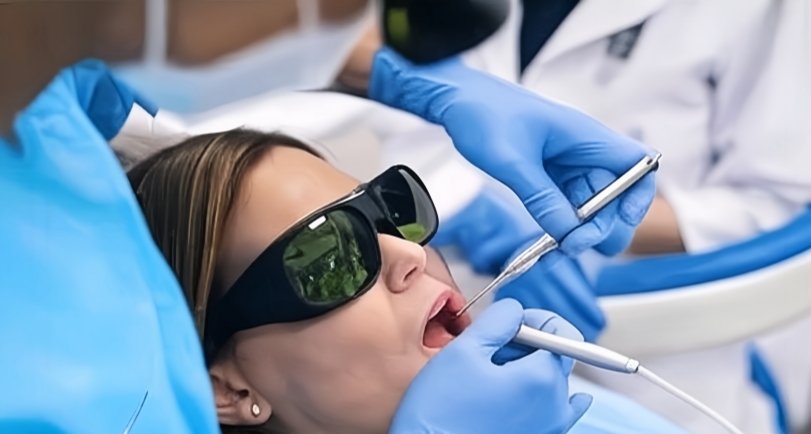
Technological advances in dentistry have brought about many innovations in the treatment of dental problems. One such advancement involves the use of laser technology, whereby light energy is concentrated on particular dental procedures without the need for conventional tools. For many people, the thought of such treatments may seem attractive, although the primary consideration should always be that of safety. Is laser dental treatment really safe, then? It can be, in appropriate situations, and when carried out by an appropriately qualified dentist using proper equipment and methods.
How Do Dental Lasers Work?
Dental lasers use concentrated light energy to treat soft tissues, hard tissues, or both, depending on the procedure. Energy is tailored to the needs of the procedure, making it possible for a dentist to shape, cut, or cure specific areas.
Unlike traditional dental drills, lasers operate with the help of light energy. Its efficiency is determined by the type of treatment, equipment, and qualification of the dentist.
Why Do Dentists Use Lasers?
Lasers are useful for various dental treatments. Soft-tissue lasers can be helpful in reshaping gums, treating some gum diseases, removal of excess tissue, or handling limited areas of oral tissue. Some lasers are even useful for hard-tissue treatments.
A possible benefit could be precise treatment. As the energy can be directed toward one particular area, there would be minimal interference to the surrounding tissue. There would also be decreased chances of bleeding.
Does It Hurt?
There are differences in pain experiences depending on the individual and the procedure. There may be laser procedures which will result in no pain at all, while there will also be others that will still need local anesthesia. The fact that it is a laser procedure does not necessarily mean that it is a pain-free one.
Some people report feelings of warmth, pressure, sensitivity, and soreness.
What Are the Possible Risks?
No medical procedure can be performed without any risks. The procedure of using lasers can lead to complications when wrong parameters are applied or when the laser beam is not directed properly, which can lead to some side effects such as inflammation, increased sensitivity, pain, changes in tissues, etc.
It is also possible that healthy tissue can be affected by the laser improperly used. It is important that the person who applies the laser is well trained.
What Safety Measures Are Used?
There are certain safety measures that are needed to conduct laser treatments. Dentists and their patients will be required to have eye protection for laser wavelengths. This is also an area that needs to be handled very carefully.
It is important for a dentist to assess one’s oral and medical history prior to advising a laser procedure. There are some oral conditions, medicines, treatment and locations that determine whether a laser can be applied or not.
Is Laser Treatment Safe for Everyone?
Not necessarily. A procedure which might be best for one person is not always good for everyone else. The dental problem at hand, the kind of tissue to be treated, the oral state of health, and the aim of treatment are some factors that will affect the selection.
Inquire about the reason why the dentist wants you to undergo the laser treatment, instead of opting for this treatment only because it sounds more advanced.
How to Prepare for a Laser Procedure
The preparation process normally starts with an examination and a discussion regarding the intended treatment. Ask the type of laser to be used, if anesthesia is required, and how the recovery process may feel. Follow your dentist’s advice on anything else that might affect the treatment.
What Is Recovery Like?
Recovery is contingent upon the type of procedure and the extent of the treatment applied. The patient may resume normal activities very fast in some cases, while for other patients, some resting period might be required. Mild soreness or sensitivity could also take place.
Your dentist could advise you regarding some particular food items, oral care practices, and changes in your routine, which may help you in your recovery process.
Understanding Your Treatment Options
Prior to selecting a laser treatment for your dental problem, it is good to have an idea of why it has been recommended by your dentist. Also, having some knowledge on alternatives, the type of the laser, the medical condition that you want to treat, the anticipated recovery period, and the possible complications will help you make up your mind and feel more comfortable during the treatment.
Conclusion
Lasers can serve as a beneficial tool in dental practice, but there are additional factors which influence safety. The need for proper diagnosis, correct laser settings, training of the dentist, use of protective means and postoperative care is very important. Not every patient and each dental problem requires the use of lasers. Hence, each case must be evaluated individually and not simply because the technique is widely used nowadays. If you are thinking about undergoing dental laser treatment, talk to your dentist about the reasons, possible alternatives, risks and recovery period. Montclair Dental Spa NJ may be your first point of contact.