Adults often assume that orthodontic treatment is mainly intended for straightforward cosmetic concerns. In reality, tooth misalignment can involve several issues at once, including crowding, spacing, rotated teeth, uneven bites, and changes that have developed gradually over the years. Modern digital dentistry has changed how these concerns can be assessed and planned.
For adults considering orthodontic treatment, orthodontic aligners offer a discreet approach that can fit into professional and personal routines. When combined with digital scans, detailed treatment planning, and appropriate clinical supervision, aligner therapy can provide a structured way to address many types of tooth movement.
Why Complex Tooth Misalignment Requires Careful Planning
Not every misaligned smile can be approached in the same way. A patient may have overlapping teeth in one area, unwanted spacing in another, and bite-related concerns that also need attention. Previous dental work, tooth shape, gum health, and the position of individual teeth can further influence the treatment plan.
This is why an assessment should go beyond simply looking at whether teeth appear crooked. A dental professional needs to understand how the teeth relate to one another and how they function together.
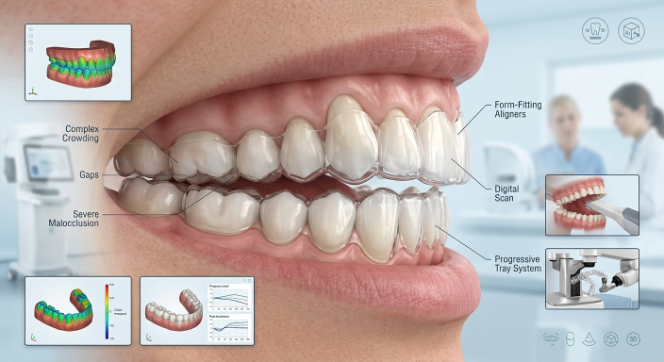
Complex cases may involve:
- Significant crowding that limits available space
- Teeth that have rotated from their natural position
- Gaps between several teeth
- Irregular relationships between the upper and lower arches
- Bite concerns that accompany visible misalignment
The treatment approach depends on the individual situation. Digital technology can help clinicians gather more precise information before deciding whether aligner treatment is suitable.
How Digital Dentistry Changes the Planning Process
Traditional impressions are not the only way to record the shape and position of teeth. Digital intraoral scanning allows a three-dimensional representation of the mouth to be created without relying on conventional impression materials.
The resulting digital model can help the dental team examine tooth positions from different angles. This information can then contribute to a treatment plan designed around the patient’s specific anatomy.
Digital workflows can also make communication easier. Instead of relying solely on physical models, clinicians can use digital records to evaluate planned tooth movements and discuss the proposed approach with patients.
Digital Scanning and Treatment Visualization
One of the useful aspects of digital planning is the ability to visualize the proposed sequence of tooth movement.
This does not mean a computer image should be treated as a guarantee of the final result. Biological responses vary between individuals, and treatment may need to be adjusted as it progresses.
However, a digital treatment plan can provide a clearer framework for understanding where the teeth are starting and what movements may be planned.
Why Adult Patients May Need a Different Approach
Adult orthodontic patients often bring a different set of considerations to treatment. Their teeth may have shifted over time, and some may have fillings, crowns, missing teeth, or other previous dental work.
Lifestyle also matters. Adults may be balancing work, family responsibilities, travel, meetings, and social commitments. A treatment option that can be removed when eating and designed to be less visually noticeable can therefore be appealing to some patients.
Still, convenience should not be the only consideration. The priority should be whether the chosen treatment can appropriately address the patient’s orthodontic needs.
For adults with more complicated alignment concerns, the assessment stage is particularly important because the visible appearance of the teeth may not tell the complete story.
Where Orthodontic Aligners Can Fit Into Complex Treatment
Modern aligner systems are designed to apply controlled forces to gradually move teeth. A series of trays may be produced according to a planned sequence, with each stage intended to move selected teeth toward their target positions.
Depending on the case, attachments or other techniques may be used to improve how certain movements are achieved.
The suitability of aligners depends on factors such as:
- The type and severity of the misalignment
- The required tooth movements
- The patient’s oral health
- Previous dental treatment
- Bite relationships
- The ability to follow the prescribed wear schedule
A professional assessment is therefore essential. A person should not choose aligners simply because they appear more convenient or discreet than another orthodontic option.
Understanding Tooth Movement Rather Than Just Appearance
A common misconception is that orthodontics is primarily about making teeth look straighter. While appearance is an important reason many adults seek treatment, tooth positioning can also affect how the upper and lower teeth meet.
When teeth are positioned unevenly, some areas may experience different contact patterns during biting and chewing. Addressing alignment therefore involves more than creating a visually attractive row of teeth.
A comprehensive treatment plan considers both aesthetics and function. The precise objectives depend on the patient’s existing dental condition and the professional assessment.
The Role of Digital Models in Complex Cases
Digital models can provide detailed information that helps clinicians examine tooth positions before treatment begins. They can also support the creation of a staged treatment sequence.
For patients, this technology can make consultations more understandable. Instead of discussing tooth movement only in abstract terms, a dental professional may be able to use the digital model to demonstrate the planned direction of movement.
This can be especially useful when several teeth require different types of movement.
Why One Treatment Plan Does Not Fit Everyone
Two adults can have teeth that look similarly crowded while requiring very different treatment strategies. Differences in root positions, bite relationships, tooth shape, previous dental procedures, and available space may influence the recommended approach.
This is why online examples and other people’s treatment experiences should not be used as substitutes for a professional assessment.
Digital technology improves the information available to clinicians, but it does not remove the need for clinical judgment.
Preparing for Treatment Before the First Aligner
Good preparation can make the treatment process more predictable. Before starting, patients should understand the recommended wearing schedule, cleaning requirements, appointment plan, and what to do if an aligner is lost or damaged.
Oral health should also be addressed. Existing dental problems may need attention before orthodontic movement begins.
A useful preparation checklist can include:
- Completing the recommended dental and orthodontic assessment
- Discussing previous dental work with the clinician
- Understanding the proposed treatment stages
- Asking how progress will be monitored
- Learning how the aligners should be cleaned and stored
- Understanding what situations may require professional advice
Taking these steps before treatment can prevent avoidable confusion later.
What Makes Professional Monitoring Important
Even when a treatment plan has been digitally designed, orthodontic treatment remains a biological process. Teeth and supporting tissues respond individually, which means the actual progress needs to be monitored.
Regular check-ins allow the dental professional to assess whether treatment is progressing as expected. If something changes, the plan can be reviewed rather than allowing a problem to continue unnoticed.
Professional monitoring is also useful when an aligner does not fit as expected or when a patient experiences persistent discomfort.
A provider such as Angel Aligner can be part of the professional support patients seek when exploring modern aligner-based treatment. The important consideration is not simply having access to aligners, but receiving appropriate assessment, planning, and follow-up throughout the process.
Managing Expectations With More Complicated Alignment
Patients with significant misalignment may naturally hope for a quick transformation. However, orthodontic movement takes time, and treatment duration varies considerably between individuals.
The number of aligners is not necessarily the only measure of complexity. Some tooth movements may require more careful staging, while others may respond differently from what was initially anticipated.
Patients should therefore focus on following the prescribed plan rather than comparing their progress with someone else’s experience.
Why Treatment Plans Sometimes Change
A digital plan represents a proposed sequence rather than a promise that every stage will happen exactly as predicted.
If teeth do not track according to the expected movement, adjustments may be necessary. In some cases, additional aligners or refinements may be recommended.
This is not necessarily a sign that treatment has failed. Orthodontic treatment often involves monitoring and adapting to the way an individual’s teeth respond.
Daily Responsibilities Still Matter
Advanced technology does not eliminate the patient’s role in treatment. Removable aligners depend on consistent use according to the instructions provided by the dental professional.
Patients should also maintain good oral hygiene and take care of the trays while they are not being worn.
Important habits include:
- Wearing the aligners according to the prescribed schedule
- Removing them when instructed for meals or specific activities
- Cleaning them using the recommended method
- Keeping them in their protective case when removed
- Contacting the dental provider if a tray is lost, damaged, or no longer fits properly
These basic habits support the larger treatment plan.
What Adults Should Consider Before Choosing Aligners
The decision to use aligners should be based on clinical suitability as well as personal preferences. Adults should consider how the treatment fits into their schedule, but they should also understand the level of commitment involved.
Questions worth discussing with a dental professional include:
- Is aligner treatment suitable for my specific type of misalignment?
- What movements are expected during treatment?
- How will my progress be monitored?
- Could additional treatment stages be required?
- What should I do if an aligner stops fitting properly?
- How might existing dental work affect treatment?
Having these conversations early can help patients develop realistic expectations.
Long-Term Considerations After Teeth Are Straightened
Completing active orthodontic treatment is not necessarily the end of the process. Teeth can shift over time, which is why retention is commonly an important part of maintaining the result.
The type and duration of retention will depend on the individual’s treatment plan. Patients should follow their professional’s recommendations rather than assuming that teeth will remain permanently in exactly the same positions without support.
Long-term oral health also matters. Regular dental examinations, good brushing and flossing habits, and professional cleaning when appropriate remain important after orthodontic treatment is completed.
When Digital Dentistry and Human Expertise Work Together
The real value of modern orthodontic technology is not that it replaces dental professionals. Its value comes from giving them better tools for examining, planning, communicating, and monitoring treatment.
Digital scans can provide detailed models. Computer-assisted planning can help organize stages of tooth movement. Progress records can support ongoing assessment. Yet clinical experience remains necessary to determine whether a particular plan makes sense for the individual patient.
For adults with complex alignment concerns, that combination of technology and professional oversight can be particularly important.
Conclusion
Modern orthodontic treatment has moved well beyond the idea of simply placing appliances on teeth and waiting for them to shift. Digital dentistry now provides clinicians with sophisticated ways to record tooth positions, plan movement, visualize treatment stages, and monitor progress.
For suitable patients, orthodontic aligners can provide a discreet and removable approach to correcting certain types of misalignment. Their success, however, depends on more than the technology behind the trays. Careful diagnosis, realistic treatment planning, professional monitoring, good oral hygiene, and patient consistency all play important roles.
Adults considering treatment should therefore look at the complete process rather than focusing only on how the aligners look. A thorough professional assessment can help determine whether aligner therapy is appropriate and what the treatment journey may involve.
FAQs
Can adults with complex misalignment use aligners?
Some adults with complex alignment concerns may be suitable for aligner treatment, while others may require a different orthodontic approach. Suitability depends on the individual’s teeth, bite, oral health, and required movements.
How does digital scanning help with aligner treatment?
Digital scanning creates a detailed three-dimensional model of the teeth. This information can assist with treatment planning and help clinicians evaluate proposed tooth movements.
Are digital treatment simulations guaranteed results?
No. A digital simulation represents a planned treatment sequence rather than a guarantee. Actual tooth movement can vary between patients and may require adjustments.
Can aligners correct rotated teeth?
Certain rotated teeth can be treated with aligners, depending on the degree of rotation and other clinical factors. A professional assessment is needed to determine whether the planned movement is suitable.
Do adults need retainers after aligner treatment?
Retention is commonly recommended because teeth can shift after active orthodontic treatment. The specific type and schedule depend on the individual treatment plan.
How important is professional monitoring?
Regular monitoring helps the dental professional evaluate progress and identify issues that may require changes to the treatment plan. It is an important part of responsible orthodontic care.