Navigating dental insurance often feels like balancing quality care against unpredictable out-of-pocket costs. Traditional dental insurance policies frequently enforce stringent waiting periods, rigid spending caps, and flat benefit percentages that rarely reward patient loyalty or continuous preventive maintenance. For individuals, families, and retirees seeking more comprehensive oral healthcare security, a progressive dental plan represents a smarter, value-driven alternative.
Unlike conventional fixed policies, a progressive dental plan is structured around a tiered, escalating framework. As you maintain continuous coverage year after year, your coinsurance percentages rise and your annual spending maximums expand. This model transforms oral healthcare from a reactive, emergency-driven expense into a predictable, rewarding long-term investment. By aligning insurer incentives with regular patient checkups, this framework ensures that keeping your smile healthy becomes more affordable with every passing year.
What Is a Progressive Dental Plan and How Does It Function?
At its core, a progressive dental plan is an insurance policy engineered to reward policyholder longevity. In a standard dental Preferred Provider Organization (PPO) plan, benefits remain static: basic restorations might always sit at 80% coverage while major procedures remain at 50%, bound to a fixed annual maximum of $1,000 or $1,500 that never increases. Conversely, a progressive dental plan increases the insurer’s share of costs across consecutive plan years.
When you enroll in a progressive dental plan, your first-year coverage handles essential preventive services right away while providing baseline coverage for fillings, extractions, or minor procedures. As you step into Year Two and Year Three without a break in coverage, the policy “steps up” its financial contribution. A procedure that covered 60% of basic restorative work during your initial twelve months might escalate to 70% in your second year, reaching 80% or higher by your third year.
Simultaneously, the plan’s annual maximum—the total dollar amount the insurer pays out in a calendar or plan year—regularly scales upward. Where standard insurance plans restrict you to the same cap year after decade, a progressive dental plan often elevates a starting $1,000 maximum to $1,500 in Year Two, $2,000 in Year Three, and even $3,000 or beyond in subsequent years. This scaling mechanism protects members who anticipate needing extensive rehabilitative or cosmetic restorative work down the road.
Key Benefits of Enrolling in a Progressive Dental Plan
The decision to choose a progressive dental plan provides distinct clinical and economic advantages over stagnant benefit arrangements. For policyholders, the primary appeal lies in substantial financial accumulation. Dental care costs, particularly for complex prosthetics, endodontics, and periodontics, have steadily risen due to advanced digital diagnostics and specialized clinical materials. Having your insurance allowance expand alongside those clinical needs eliminates the fear of hitting arbitrary coverage ceilings midway through an extensive restorative plan.
Another core advantage is immediate access to preventive care. Progressive dental plans prioritize early detection, ensuring checkups, bitewing X-rays, and professional prophylaxis are covered at or near 100% from day one. By removing the financial barrier to routine maintenance, these plans encourage proactive appointments, catching micro-cavities, gingival inflammation, and enamel wear long before they escalate into painful root canals or fractured cusps.
Furthermore, a progressive dental plan provides predictable budgeting for households. Families often put off complex procedures like orthodontic aligners, pediatric space maintainers, or multi-unit bridges because of upfront expenses. Knowing that your benefits step up automatically over time gives you the power to schedule phased multi-stage treatments in tandem with your expanding annual allowances.
Year-by-Year Breakdown: How Escalating Coverage Works
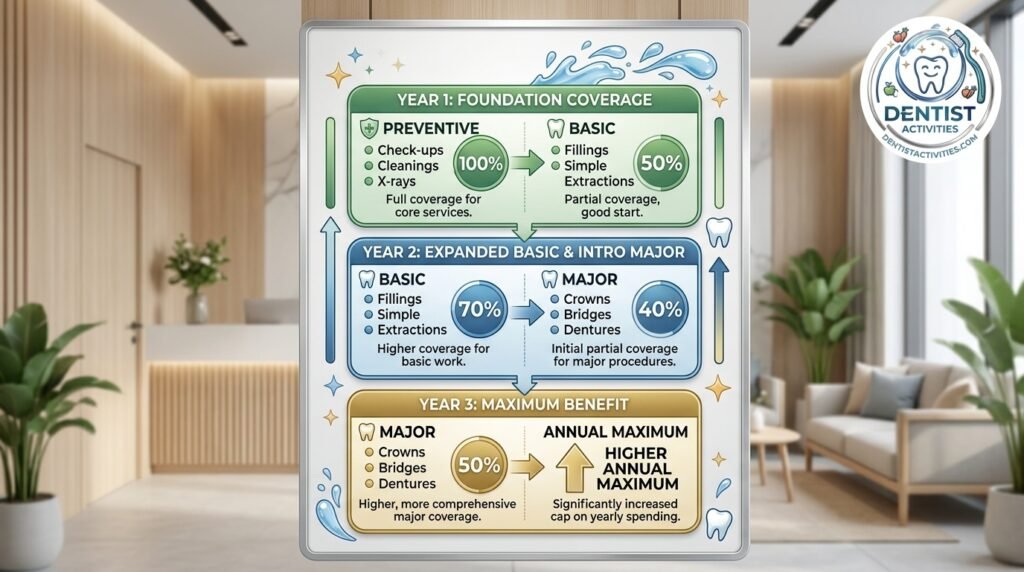
Understanding how benefits scale across consecutive policy terms clarifies why progressive dental coverage offers compounding value over time. While exact schedule percentages depend on the specific carrier, the structural progression follows a clear, rewarding rhythm:
Year One: The Foundation Stage
During the first twelve months of enrollment, the primary objective is stabilizing oral health. Preventive services—including bi-annual comprehensive cleanings, periodontal examinations, fluoride treatments, and full-mouth radiographic series—are typically covered at 80% to 100% without prolonged delays. Basic restorative care, like simple amalgam or composite resin fillings and non-surgical tooth extractions, usually commands 50% to 60% coverage. Major restorative treatments (crowns, onlays, deep periodontal scaling) may carry a modest coinsurance tier or require completion of an introductory period, alongside a baseline annual maximum of $1,000 to $1,200.
Year Two: The Intermediate Step-Up
Once you renew into your second consecutive policy year, your coinsurance percentages rise. Basic restorative care frequently climbs to 70% or 80%, reducing your copayment at the dental checkout counter. Concurrently, major restorative care unlocks at an elevated rate, often jumping from minimal assistance up to 30% or 40% of contracted allowable charges. The annual maximum typically sees its first milestone expansion, stepping up to $1,500 or $1,750. This creates the ideal window to address minor chronic issues before they compromise adjacent dentition.
Year Three and Beyond: Peak Benefit Maturity
By the third consecutive year, a progressive dental plan reaches its mature status. Basic treatments generally achieve optimal coverage, paying 80% to 90%, while complex restorative procedures (endodontic root canal therapies, porcelain-fused-to-zirconia crowns, complete dentures, and surgical implants) reach their maximum coverage threshold of 50% to 60%. Most importantly, the annual maximum commonly expands to $2,000, $2,500, or even $3,000. For members requiring full-arch restoration or advanced periodontal management, this mature tier provides significant out-of-pocket relief.
Progressive Dental Plans vs. Traditional Dental Insurance
To clearly understand why more patients are shifting toward progressive models, it is essential to compare the structural differences between traditional plans and progressive alternatives:
| Feature | Traditional Dental Insurance | Progressive Dental Plan |
|---|---|---|
| Annual Maximums | Fixed annually (typically $1,000–$1,500); remains static forever | Escalates annually (e.g., $1,000 Year 1 → $1,500 Year 2 → $2,500+ Year 3) |
| Coverage Percentages | Static percentage formula (e.g., rigid 100/80/50 breakdown) | Tiered percentage growth across basic and major categories |
| Loyalty Incentives | None; benefits remain identical regardless of tenure | Substantial; continuous membership unlocks maximum cost savings |
| Waiting Period Impact | Restrictive waiting periods often delay care without increasing future benefits | Waiting thresholds transition directly into escalating coinsurance tiers |
| Treatment Planning | Difficult to phase large treatments due to low annual spending caps | Optimized for multi-stage phased treatments across policy renewal cycles |
Conventional insurance often punishes patients who maintain continuous coverage by offering zero cumulative reward. A policyholder who pays premiums for five years under a traditional plan receives the exact same annual maximum and copay rate in year five as a brand-new enrollee. In contrast, a progressive dental plan actively rewards continuous membership, compounding the return on your premium payments over time.
How Annual Maximums and Deductibles Scale
Two critical financial pillars govern any dental policy: the deductible and the annual maximum. Under a progressive dental plan, these financial mechanics operate in tandem to optimize your out-of-pocket spending limits.
The annual deductible in a progressive policy is typically straightforward, often set between $50 and $100 per person per calendar year, with aggregate family caps around $150 to $300. In many modern progressive policies, preventive services bypass the deductible entirely, meaning you do not have to pay out of pocket before receiving standard hygiene cleanings and clinical exams.
The annual maximum is where the progressive architecture delivers standout value. Standard dental policies have retained an infamous $1,000 to $1,500 cap since the 1970s, despite decades of healthcare inflation. When a single dental crown and post-and-core buildup can easily cost $1,200 to $1,800, a traditional cap is exhausted by a solitary procedure, leaving the patient solely responsible for any subsequent treatment.
A progressive dental plan directly remedies this limitation. By methodically stepping up the annual limit by several hundred dollars each consecutive year, the plan allows members to plan major oral surgeries, cosmetic crowns, or implant placements without exceeding their insurance ceiling mid-treatment.
Understanding Waiting Periods and Continuous Coverage Rules
To fully capitalize on the advantages of a progressive dental plan, members must adhere to specific continuity rules. Because progressive plans offer substantial savings in subsequent years, carriers put measures in place to mitigate adverse selection—the practice where a patient enrolls, receives extensive major work immediately, and promptly cancels the policy.
The primary requirement for securing tiered benefit increases is unbroken, continuous coverage. Your anniversary date or policy calendar cycle dictates when your benefits advance to the next level. If a policy lapses due to non-payment or voluntary cancellation, the progressive clock usually resets back to Year One benchmarks upon re-enrollment. Maintaining active premium payments is therefore vital to safeguarding your hard-earned tier status.
Many progressive policies also feature built-in waiting period credits. If you transition directly from a prior credible dental plan without a coverage gap (often defined as fewer than 30 to 63 days), some progressive dental plans will credit your prior tenure. This allows you to step directly into Year Two or Year Three coverage tiers immediately, bypassing introductory basic restorative waiting periods. Always request a formal waiver or proof-of-prior-coverage verification when switching carriers.
Maximizing Value: Smart Treatment Planning with a Progressive Dental Plan

Holding a progressive dental plan empowers you and your clinical provider to approach long-term dental care strategically. Rather than rushing into expensive, fragmented emergency treatments, you can establish an individualized multi-year treatment roadmap that synchronizes clinical priorities with your expanding insurance brackets.
Step 1: Complete Diagnostics and Stabilization
In your first plan year, focus on thorough clinical assessment and stabilization. Utilize your fully covered diagnostic exams, digital periapical X-rays, and periodontal chartings to identify every potential vulnerability. Address immediate hazards such as active decay or gingival infection through standard cleanings, fluoride therapies, and basic composite fillings, which are supported by your Year One basic coverage.
Step 2: Intermediate Maintenance and Preparatory Care
As you enter your second plan year with higher basic coverage and an elevated maximum, tackle intermediate dental concerns. This phase is well-suited for multiple quadrant root planings (deep cleanings), single-tooth core buildups, or replacing failing amalgam restorations with durable onlays.
Step 3: High-Tier Restorative and Prosthetic Reconstruction
When your policy reaches its Year Three peak, your annual maximum is at its highest and major restorative coinsurance is most generous. This is the optimal window to execute high-cost rehabilitative procedures:
- Placing endodontic crowns, ceramic abutments, and porcelain bridges
- Undergoing surgical dental implant fixtures and bone grafts
- Procuring custom partial or complete digital dentures
- Addressing full-mouth occlusal rehabilitation or specialized bite adjustments
By working hand-in-hand with your dentist’s billing coordinator to phase treatments across plan renewal thresholds, you can save thousands of dollars while receiving optimal clinical care.
Who Benefits Most from a Progressive Dental Plan?
While flexible and forward-thinking, a progressive dental plan is uniquely suited to specific demographic and lifestyle profiles:
Families with Growing Children and Teenagers
Pediatric dental demands evolve constantly. Toddlers require basic cleanings and preventive sealants, while pre-teens and adolescents often need orthodontic evaluations, premolar extractions, athletic mouthguards, and wisdom teeth extractions. Enrolling young children in a progressive dental plan ensures that by the time they reach high-school age—when orthodontic and surgical demands peak—the family’s plan has matured into its highest annual maximums and lowest coinsurance copays.
Self-Employed Professionals and Freelancers
Independent contractors lack access to subsidized corporate group benefits. For these individuals, every healthcare dollar represents direct overhead. A progressive dental plan provides independent workers with affordable upfront rates that steadily grow into executive-tier coverage, protecting their health and personal savings without corporate backing.
Retirees and Seniors Transitioning Off Employer Coverage
Traditional Medicare does not provide routine dental benefits, leaving millions of seniors vulnerable to dental decay, tooth loss, and gum disease. Because dental health heavily influences systemic health—including cardiovascular balance, cognitive wellness, and diabetic control—seniors need steady, high-capacity dental protection. A progressive dental plan allows retirees to comfortably preserve their natural teeth, plan for future bridges or implants, and maintain dentures without facing exorbitant out-of-pocket bills.
Frequently Asked Questions (FAQs)
What happens to my progressive dental plan tier if I miss a premium payment?
If a payment is missed and your policy enters a default cancellation status, your accumulated tier level is typically lost. If you reinstate your policy after a lapse, most insurers treat you as a new applicant, resetting your benefits to the Year One coverage tier. To prevent this, consider setting up automated electronic payments to safeguard your progressive status.
Can I skip Year One and immediately access Year Three benefits?
Under standard circumstances, you cannot simply skip into Year Three without meeting tenure requirements. However, certain progressive dental plan providers offer waiting period waivers or tier credits if you transition seamlessly from a comparable dental plan without an interruption in coverage. You will need to provide a formal Certificate of Creditable Coverage from your previous insurance carrier.
Are cosmetic treatments like teeth whitening covered under a progressive dental plan?
Purely elective aesthetic procedures, such as chairside teeth whitening, direct composite veneers, or cosmetic bonding, are generally excluded from standard insurance contracts. However, when cosmetic restorations also provide structural and clinical value—such as tooth-colored ceramic crowns or natural-shaded bridge pontics on anterior teeth—progressive plans often provide coverage under their major restorative tiers.
Does a progressive dental plan restrict my choice of dentists?
Most progressive policies operate under a Dental PPO (DPPO) network architecture. This gives you the freedom to visit any licensed dental provider you choose. However, to maximize your savings, it is best to visit an in-network participating dentist. In-network providers agree to contracted, discounted fee schedules, compounding the savings offered by your progressive plan’s escalating percentages.
How does an increasing annual maximum help if I only need regular cleanings?
Even if your oral health is currently in pristine condition, unexpected accidents and underlying issues can occur without warning. An old filling can fracture, a sports injury can crack an incisor, or age-related recession can expose roots to rapid decay. Having an annual maximum that has graduated to $2,000 or $3,000 provides a financial safety net, ensuring you are immediately prepared for unexpected dental needs without draining your emergency savings.
Conclusion: Securing Sustainable, Lifelong Dental Wellness
Maintaining radiant, functionally sound teeth requires consistent care, proactive clinical treatment, and a realistic financial strategy. Traditional dental insurance setups, burdened by static spending limits and unrewarding structures, frequently fall short of contemporary healthcare needs.
A progressive dental plan solves this dilemma by aligning insurance benefits with patient dedication. By systematically escalating coverage percentages and expanding annual maximums with each continuous year of enrollment, this dynamic model transforms dental coverage into a truly rewarding healthcare asset. Whether you are budgeting for a growing family’s future dental needs, establishing independent coverage as an entrepreneur, or safeguarding your smile through retirement, a progressive dental plan delivers the expanding security, peace of mind, and financial protection necessary for a lifetime of healthy smiles.