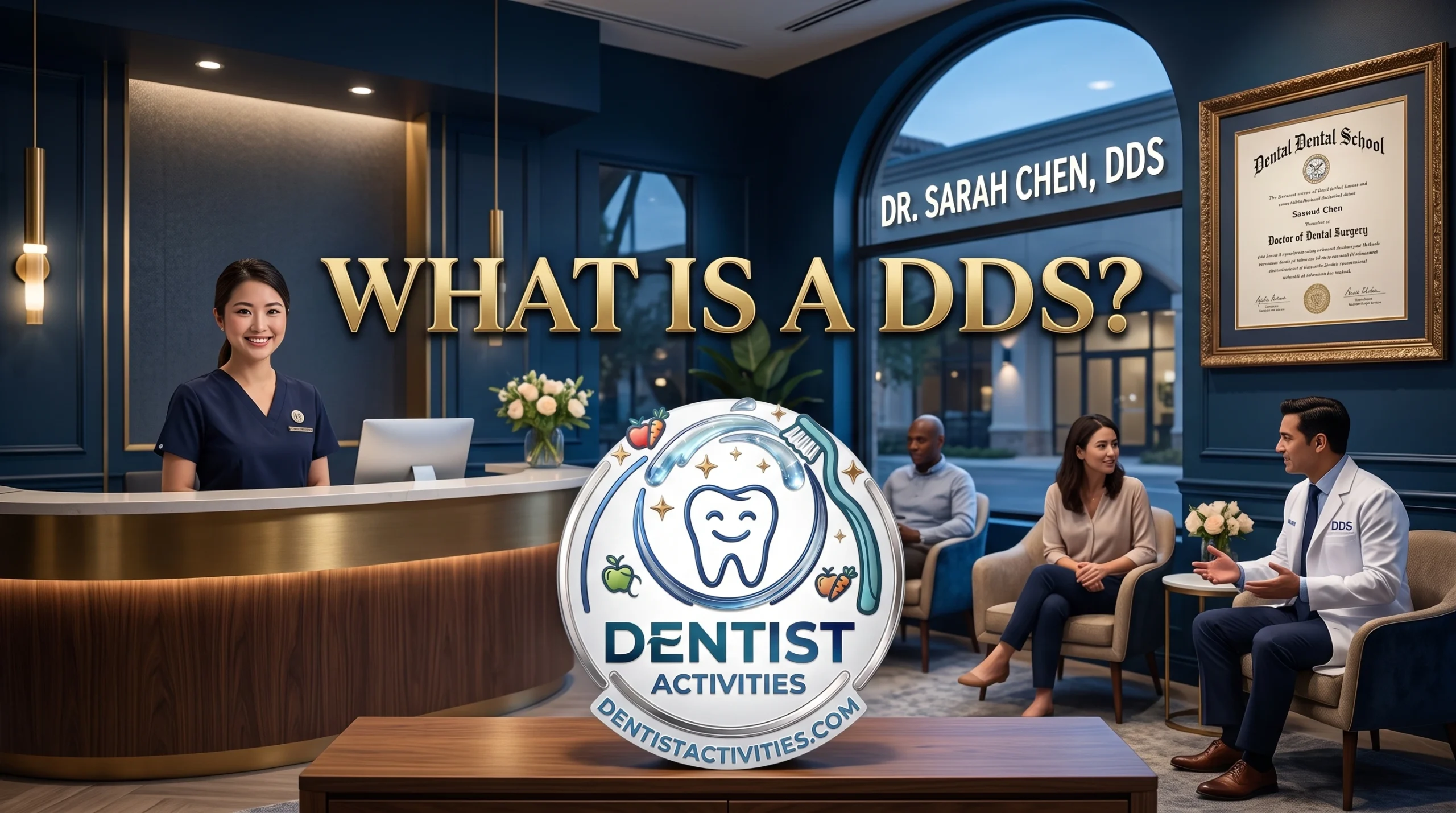
When people ask, “what is a dds?”, they are most often referring to a Doctor of Dental Surgery—an advanced professional doctoral degree awarded to practitioners who have completed comprehensive medical and clinical training to practice general or specialized dentistry.
However, the acronym DDS also surfaces across computer science, electronics, and organizational administration. Understanding what a DDS represents requires examining both its primary healthcare meaning and its technical applications.
This guide breaks down every aspect of what a DDS is, including the academic journey, clinical responsibilities, key differences between DDS and DMD credentials, career paths, earning potential, and notable non-medical definitions.
1. What Is a DDS in Healthcare and Dentistry?
A Doctor of Dental Surgery (DDS) is a graduate-level terminal medical degree that qualifies an individual to practice as a licensed general or specialist dentist. In the healthcare sector, dentists are primary oral healthcare providers responsible for diagnosing, preventing, treating, and managing disorders of the teeth, gums, jaw, and adjacent facial tissues.
A DDS is not merely a technical qualification for cleaning teeth or filling cavities; it is an extensive clinical doctoral credential. Holders of a DDS degree evaluate how systemic health conditions—such as cardiovascular disease, diabetes, and autoimmune disorders—manifest in the oral cavity.
Key Competencies of a Doctor of Dental Surgery:
- Diagnosis and Treatment Planning: Assessing patient history, reading digital radiographs, and formulating long-term therapeutic procedures.
- Surgical Interventions: Performing extractions, bone grafts, gum contouring, and placing dental implants.
- Restorative Dentistry: Placing composite fillings, crowns, bridges, and inlays.
- Endodontics and Periodontics: Treating root canal infections, periodontal pockets, and gum disease.
- Preventative Care: Applying sealants, fluoride treatments, and counseling patients on oral hygiene and nutrition.
2. DDS vs. DMD: What Is the Difference?
One of the most frequent points of confusion for prospective students and dental patients is the relationship between DDS (Doctor of Dental Surgery) and DMD (Doctor of Dental Medicine or Doctor Medicinae Dentariae).
Are DDS and DMD Degrees Identical?
Yes. The American Dental Association (ADA) and the Commission on Dental Accreditation (CODA) recognize DDS and DMD as completely equivalent degrees. They have the same curriculum requirements, state licensing board exams, clinical standards, and legal scope of practice.
| Attribute | Doctor of Dental Surgery (DDS) | Doctor of Dental Medicine (DMD) |
|---|---|---|
| Origin of Title | Baltimore College of Dental Surgery (1840) | Harvard Dental School (1867) |
| Curriculum Standard | Accredited by CODA | Accredited by CODA |
| Duration of Program | 4 years full-time | 4 years full-time |
| Licensure Requirements | INBDE + State/Regional Clinical Exam | INBDE + State/Regional Clinical Exam |
| Scope of Practice | Full General Dentistry & Specialties | Full General Dentistry & Specialties |
| Prescriptive Authority | Full dental medical prescription rights | Full dental medical prescription rights |
Why Do Two Different Dental Degree Names Exist?
The distinction is historical. In 1840, the world’s first dental school, the Baltimore College of Dental Surgery, created the title Doctor of Dental Surgery. In 1867, Harvard University established its own dental medicine department. Harvard granted all degrees in Latin, and because there was no direct Latin equivalent for “Doctor of Dental Surgery,” they coined Dentariae Medicinae Doctor (DMD). Today, universities independently choose which title to confer, but both train students under identical national standards.
3. Educational Path: How to Earn a DDS Degree
Earning a DDS requires dedication, academic excellence, and a significant time commitment—typically taking eight years of higher education (four years of undergraduate study followed by four years of dental school).
Step 1: Complete an Undergraduate Bachelor’s Degree
Aspiring dentists complete a four-year bachelor’s degree, commonly in biology, chemistry, biochemistry, or pre-health sciences. Prerequisite courses include:
- General Chemistry with Lab (2 semesters)
- Organic Chemistry with Lab (2 semesters)
- General Biology with Lab (2 semesters)
- General Physics with Lab (2 semesters)
- Biochemistry, Microbiology, and Anatomy
- English Composition and Mathematics/Calculus
Step 2: Take the Dental Admission Test (DAT)
The DAT is a standardized examination administered by the ADA that evaluates academic capacity and scientific comprehension. It covers:
- Survey of Natural Sciences: Biology, General Chemistry, and Organic Chemistry.
- Perceptual Ability Test (PAT): Spatial visualization, 3D manipulation, and angle discrimination (vital for clinical hand skills).
- Reading Comprehension: Scientific and general passages.
- Quantitative Reasoning: Applied mathematics, algebra, and probability.
Step 3: Attend an Accredited 4-Year Dental School
Once admitted via the ADEA AADSAS centralized application system, dental students complete a rigorous four-year program:
- Years 1 & 2 (Pre-Clinical Foundations): Focus on biomedical sciences (gross anatomy, physiology, pharmacology, pathology, histology) paired with intensive preclinical simulation lab courses (waxing, cavity prep, prosthodontics).
- Years 3 & 4 (Clinical Practice): Direct patient care in university dental clinics under the supervision of licensed faculty, rotating through pediatric dentistry, oral surgery, periodontics, and emergency triage.
4. Licensure and Board Certifications for DDS Graduates
Graduating with a DDS degree does not automatically permit a dentist to treat patients independently. Graduates must pass comprehensive board exams and satisfy state-specific licensing criteria.
Integrated National Board Dental Examination (INBDE)
The INBDE is a comprehensive cognitive exam taken during dental school that assesses a candidate’s understanding of biomedical sciences, dental sciences, and clinical decision-making.
Clinical Licensure Examinations
Candidates must complete a clinical performance examination administered by regional testing agencies (such as CDCA-WREB-CRAME or SRTA) or complete an approved one-year Postdoctoral General Dentistry residency (AEGD/GPR), depending on state law.
Additional State Requirements:
- Jurisprudence and ethics exams regarding state dental practice acts.
- Comprehensive background check and fingerprinting.
- Current Basic Life Support (BLS) and Advanced Cardiovascular Life Support (ACLS) certification.
- Drug Enforcement Administration (DEA) registration for prescribing controlled substances.
5. Daily Roles and Responsibilities of a DDS Dentist
A DDS dentist acts as both a specialized physician and a microsurgeon. Their day-to-day workflow balances technical precision with patient communication and business management.
- Oral Examination & Screening: Checking soft tissues for pre-cancerous lesions, assessing periodontal pockets, and checking for decay.
- Radiographic Interpretation: Analyzing bitewing, periapical, panoramic, and cone-beam computed tomography (CBCT) 3D scans.
- Operative Restorations: Removing caries (decay) and restoring tooth structure using composite resins, glass ionomers, or porcelain ceramics.
- Prosthetic Rehabilitation: Designing, fitting, and adjusting fixed prosthodontics (crowns, bridges) and removable appliances (complete and partial dentures).
- Local Anesthesia and Pain Management: Administering nerve blocks, infiltrations, and nitrous oxide sedation safely.
- Patient Education: Guiding patients on dietary habits, flossing techniques, systemic risks of periodontal disease, and post-operative home care.
6. Dental Specialties Available After Completing a DDS
While many graduates enter general practice immediately after licensing, a DDS degree also serves as the prerequisite foundation for recognized dental specialties. These post-doctoral residency programs require an additional 2 to 6 years of training.
- Oral and Maxillofacial Surgery (OMFS) (4–6 years): Surgical treatment of facial trauma, corrective jaw surgery (orthognathic), cleft palate repair, complex impacted wisdom teeth extractions, and facial reconstructive oncology.
- Orthodontics and Dentofacial Orthopedics (2–3 years): Diagnosis and correction of malocclusions, misaligned teeth, and facial skeletal discrepancies using braces, clear aligners, and palatal expanders.
- Endodontics (2–3 years): Specialized treatment of the dental pulp, complex root canal therapies, apicoectomies, and tooth preservation.
- Periodontics (3 years): Surgical and non-surgical management of gum diseases, soft tissue grafting, and dental implant placement.
- Pediatric Dentistry (2–3 years): Comprehensive oral care for infants, children, adolescents, and patients with special healthcare needs.
- Prosthodontics (3 years): Complex full-mouth reconstruction, maxillofacial prosthetics, and advanced implant-supported restorations.
- Dental Public Health, Oral Pathology, and Oral Radiology: Academic, diagnostic, and community-wide prevention specialties.
7. Career Outlook, Salary, and Practice Settings for DDS Holders
A career as a DDS dentist offers job security, intellectual challenge, and flexible practice arrangements.
Practice Environments
- Private Solo or Group Practice: Owning or partnering in an independent dental clinic.
- Dental Support Organizations (DSOs): Working as an associate in corporate-supported dental practices.
- Hospital Dentistry & Academic Medical Centers: Treating medically compromised patients, operating room cases, and teaching dental students.
- Public Health Clinics & Military Service: Providing oral healthcare in underserved community health centers, VA hospitals, or active-duty armed forces bases.
Compensation and Job Growth
According to the U.S. Bureau of Labor Statistics (BLS), general dentists earn a median annual wage exceeding $160,000 to $180,000, with top earners and surgical specialists (such as endodontists and oral surgeons) frequently earning upwards of $250,000 to $400,000 annually. Demand for dental professionals remains steady due to an aging population, increasing awareness of oral-systemic health connections, and advancements in cosmetic dentistry.
8. What Is a DDS in Technology and Other Industries?
Outside of medicine and dentistry, the abbreviation DDS refers to several technical and organizational terms:
Data Distribution Service (DDS) in Software Engineering
In computer science, Data Distribution Service (DDS) is an Object Management Group (OMG) open middleware standard designed for high-performance, real-time, data-centric machine-to-machine (M2M) communications.
- Uses a publish-subscribe (Pub/Sub) architecture.
- Widely used in autonomous driving, aerospace telemetry, robotics, industrial IoT, and defense systems where microsecond-level latency and fault tolerance are mission-critical.
Direct Digital Synthesis (DDS) in Electronics
In electrical engineering and telecommunications, Direct Digital Synthesis (DDS) is a technique used for generating arbitrary frequency- and phase-tunable analog waveforms from a single, fixed-frequency reference clock. DDS frequency synthesizers are foundational in radio transmitters, signal generators, MRI machines, and radar equipment.
Disability Determination Services (DDS) in Government
In the United States, Disability Determination Services (DDS) are state-level agencies funded by the federal government that evaluate medical evidence and make eligibility determinations for Social Security Disability Insurance (SSDI) and Supplemental Security Income (SSI) applicants.
Frequently Asked Questions (FAQs)
Is a DDS considered a medical doctor?
A DDS is a doctor of dental surgery, making them a licensed physician of the oral cavity and maxillofacial region. While they hold a doctoral degree and possess prescriptive authority within their scope of practice, they are classified as dentists rather than general medical physicians (MDs or DOs).
How many years does it take to become a DDS?
It typically takes 8 years after high school: 4 years to complete a bachelor’s degree followed by 4 years of dental school. If a dentist pursues a specialty (such as orthodontics or oral surgery), an additional 2 to 6 years of residency training is required.
Is it harder to get into dental school (DDS) than medical school (MD)?
Both paths are competitive. Dental school admissions place heavy emphasis on high undergraduate GPAs, competitive DAT scores, spatial reasoning abilities (evaluated on the Perceptual Ability Test), and verified dental shadowing hours.
Can a DDS perform surgery?
Yes. A DDS is trained to perform surgical dental procedures, including routine and surgical tooth extractions, minor soft tissue biopsies, gingival surgery, and dental implant placements. Major reconstructive jaw surgeries are typically handled by Oral and Maxillofacial Surgeons (OMFS).
Do DDS dentists have to renew their licenses?
Yes. Licensed dentists must renew their state credentials periodically (usually every 1 to 3 years) by completing mandatory Continuing Education (CE) credits in pharmacology, infection control, medical emergencies, and clinical techniques.
Conclusion
Understanding what is a dds provides clarity on both a prestigious healthcare profession and vital concepts in modern technology. In the medical sphere, a Doctor of Dental Surgery represents years of intensive scientific education, clinical training, and professional licensing dedicated to preserving oral and systemic health. Whether compared against a DMD or evaluated as a career path, the DDS credential stands as a gold standard in patient-centered oral medicine.