
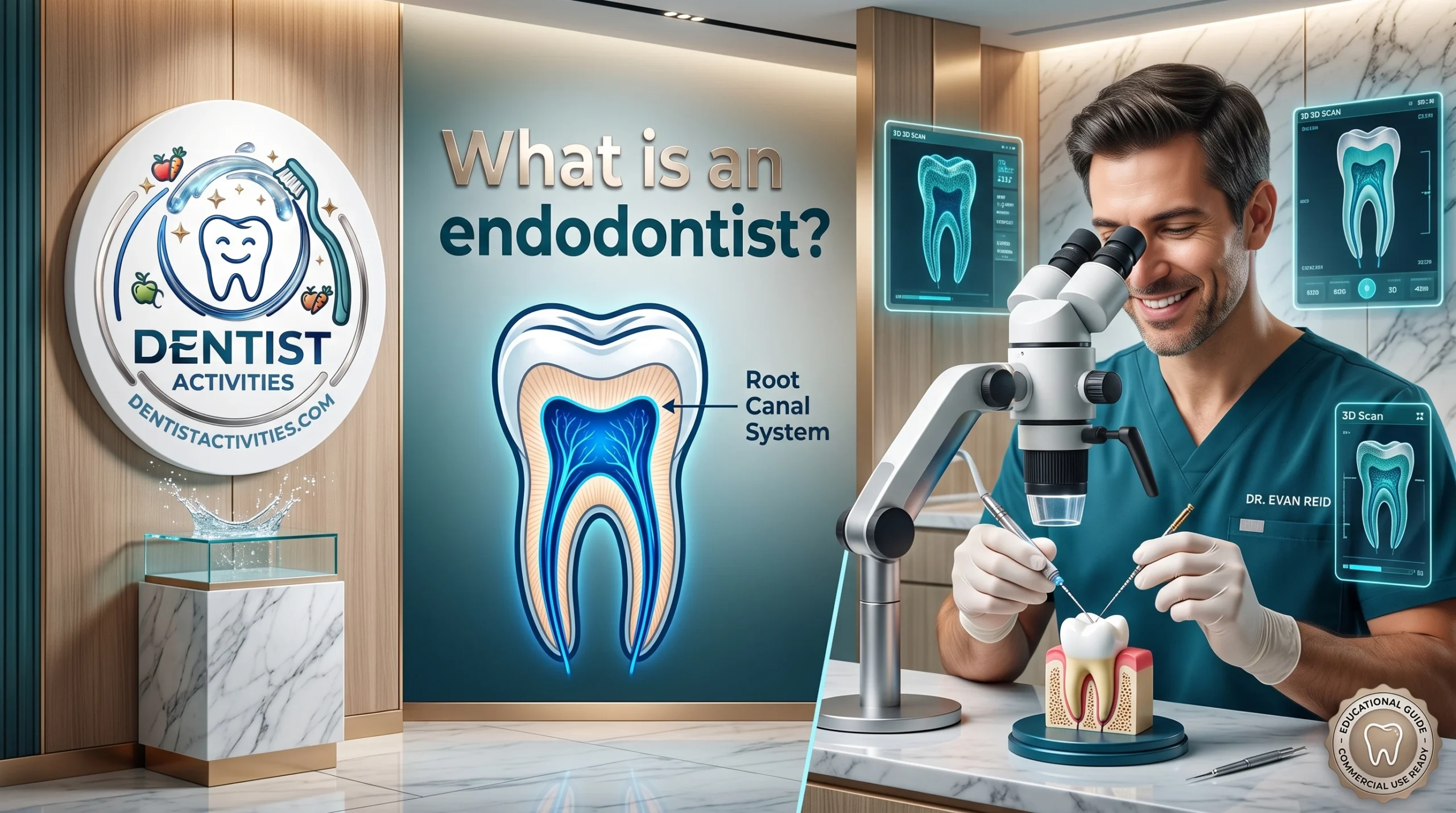
Experiencing severe tooth pain, persistent sensitivity to hot or cold drinks, or swelling around your gums can disrupt your daily routine. When standard dental care is insufficient to resolve deep-seated pain inside a tooth, general dentists typically refer patients to an endodontist.
Understanding what is an endodontist, what specialized procedures they handle, and how their advanced expertise can save natural teeth is essential for making informed oral healthcare choices.
1. What Is an Endodontist? Definition and Core Purpose
An endodontist is a dental specialist who focuses exclusively on diagnosing tooth pain and treating issues related to the dental pulp and tissues surrounding the roots of teeth. The term originates from the Greek words “endo” (meaning inside) and “odont” (meaning tooth).
While general dentists care for teeth, gums, and oral hygiene broadly, endodontists concentrate on the complex internal structures of the tooth.
The Anatomy of the Tooth
To fully understand what an endodontist does, it helps to examine basic tooth anatomy:
- Enamel: The hard, mineralized outer layer protecting the crown.
- Dentin: The supportive, porous layer located beneath the enamel.
- Dental Pulp: The innermost living tissue containing blood vessels, connective tissues, and nerves that run down into the root canals.
When deep decay, repeated dental procedures, cracks, or physical trauma compromise the dental pulp, bacteria invade, resulting in severe inflammation, infection, or abscess formation. An endodontist specializes in removing damaged pulp, disinfecting the internal root canals, and sealing the space to preserve the natural tooth.
2. Endodontist vs. General Dentist: What Is the Difference?
All endodontists are licensed dentists, but less than 3% of all practicing dentists are board-certified or specialty-trained endodontists.
Understanding how their training and clinical practice differ helps clarify when a specialist is necessary:
| Feature | General Dentist | Endodontist |
| Primary Scope | Cleanings, fillings, crowns, extractions, preventive care | Root canals, endodontic retreatment, microsurgery, dental trauma |
| Additional Education | 4 years dental school (DDS/DMD) | 4 years dental school + 2 to 3 years specialized residency |
| Weekly Root Canals | ~1 to 2 procedures per week | ~20 to 30+ procedures per week |
| Specialized Equipment | Standard loupes, digital X-rays | Operating microscopes, CBCT 3D imaging, ultrasonic instruments |
| Pain Management Focus | General local anesthesia | Advanced nerve blocks, sedation, difficult-to-numb cases |
3. Education and Specialized Training of an Endodontist
Becoming an endodontist requires rigorous academic study and hands-on clinical training:
- Bachelor’s Degree: A 4-year undergraduate degree, typically in pre-dental, biology, chemistry, or related sciences.
- Dental School: 4 years of dental education to earn a Doctor of Dental Surgery (DDS) or Doctor of Dental Medicine (DMD) degree.
- Advanced Specialty Residency: 2 to 3 additional years in an accredited endodontic postgraduate residency program.
During residency, endodontists master micro-surgical techniques, advanced biomedical engineering related to endodontic materials, root canal disinfection protocols, and 3D imaging interpretation.
4. Key Procedures Performed by an Endodontist
Endodontists perform specialized treatments designed to eliminate infection and preserve the natural dentition.
Root Canal Therapy (Endodontic Treatment)
The most common procedure involves making a conservative opening in the tooth’s crown, removing infected or necrotic pulp tissue, reshaping and disinfecting the microscopic root canals, and sealing them with a biocompatible material called gutta-percha.
Endodontic Retreatment
If a tooth fails to heal properly or develops new infection years after an initial root canal due to complex branching canals or a compromised restoration, an endodontist disassembles the previous filling, cleans the missed canals, and reseals the tooth.
Apicoectomy (Root-End Surgery)
When persistent infection remains at the root tip (apex) that cannot be resolved through standard canal pathways, an endodontist performs an apicoectomy:
- A small incision is made in the gum tissue near the root.
- The inflamed tissue and the root apex (tip) are removed.
- A small filling is placed at the root end to seal the canal.
Traumatic Dental Injury Management
Accidents, sports injuries, or falls can cause cracked, dislodged (luxated), or completely knocked-out (avulsed) teeth. Endodontists specialize in stabilizing loosened teeth, treating exposed pulp, and preventing root resorption.
Regenerative Endodontics
Used primarily in pediatric and adolescent patients, this procedure uses tissue engineering principles to revitalize damaged pulp tissue in immature permanent teeth, allowing the root walls to continue thickening and growing.
5. Advanced Technology Used by Modern Endodontists
Endodontists leverage cutting-edge technology to diagnose conditions that cannot be detected with conventional dental instruments.
- Operating Microscopes: Provide up to 25x magnification and high-intensity illumination to locate hidden, calcified, or accessory canals smaller than a human hair.
- Cone-Beam Computed Tomography (CBCT): 3D imaging technology that renders cross-sectional views of the tooth, root anatomy, and jawbone, identifying hidden infections without invasive exploratory procedures.
- Digital Apex Locators: Electronic sensors that measure the precise length of a root canal down to a fraction of a millimeter.
- Ultrasonic Instrumentation: High-frequency sonic instruments that clean calcified canal spaces and remove broken files or posts with minimal loss of tooth structure.
6. Common Symptoms Indicating You Need to See an Endodontist
Consult an endodontist if you experience any of the following symptoms:
- Spontaneous, Throbbing Pain: Lingering, severe toothache that radiates into the jaw, ear, or temple, especially when lying down.
- Prolonged Temperature Sensitivity: Sharp pain when consuming hot coffee or cold foods that lingers for more than 15–30 seconds after the temperature stimulus is removed.
- Pain When Chewing or Touching: Discomfort when biting down, indicating inflammation of the periodontal ligament surrounding the root apex.
- Gum Pimples or Abscesses: A small bump (fistula or parulis) on the gum line that releases fluid or pus.
- Tooth Discoloration: A tooth turning gray, dark yellow, or brownish after a physical impact or trauma, signaling internal nerve death.
- Facial Swelling: Noticeable swelling around the gums, cheek, or jawline.
7. What to Expect During an Endodontic Appointment
Understanding the clinical workflow helps alleviate dental anxiety before your appointment.
1. Comprehensive Diagnostic Evaluation
The endodontist performs pulp vitality tests, including cold sensitivity testing, percussion testing (tapping the tooth), periodontal probing, and 3D CBCT scans to pinpoint the affected tooth.
2. Pain-Free Local Anesthesia
Advanced local anesthetics ensure the target area is completely numb. For anxious patients, nitrous oxide, oral conscious sedation, or IV sedation options may be discussed.
3. Rubber Dam Isolation
A protective sheet called a dental dam is placed over the tooth. This isolates the tooth, maintains an aseptic (sterile) surgical environment, and prevents oral bacteria or saliva from entering the canals.
4. Cleaning, Shaping, and Sealing
Using flexible nickel-titanium (NiTi) rotary instruments, the canals are thoroughly shaped and disinfected with antimicrobial irrigants before being filled with gutta-percha and bioceramic sealers.
5. Final Restoration
After root canal treatment, you return to your general dentist for a permanent restoration, such as a custom-fitted porcelain or zirconia crown, to restore full bite strength.
8. Why Saving Your Natural Tooth Matters
While dental implants and fixed bridges are reliable tooth-replacement options, preserving your natural tooth through endodontic care offers distinct clinical and practical advantages:
- Natural Chewing Dynamics: Natural teeth maintain natural proprioception (sensory feedback on biting pressure), preventing uneven wear on opposing teeth.
- Bone Preservation: Natural roots stimulate the alveolar jawbone, preventing localized bone loss that often follows an extraction.
- Cost and Time Efficiency: A root canal and crown are generally more cost-effective and require significantly fewer visits than an extraction followed by bone grafting and implant placement.
- Aesthetic Alignment: Maintaining your natural tooth structure preserves normal gum contours and dental arch alignment.
Conclusion
An endodontist is an essential specialist in modern dentistry, combining postgraduate education, microsurgical skills, and advanced diagnostic tools to resolve severe pain and save teeth that might otherwise require extraction. If you are dealing with chronic toothaches, lingering sensitivity, or dental trauma, scheduling an evaluation with an endodontist can restore oral health and protect your natural smile.
Frequently Asked Questions (FAQs)
What is the primary role of an endodontist?
An endodontist is a dental specialist who diagnoses tooth pain and performs treatments involving the internal dental pulp and roots, most commonly root canal therapy and microsurgery.
Is seeing an endodontist painful?
Modern endodontic procedures are virtually painless. With advanced local anesthetics and microscopic techniques, receiving a root canal from an endodontist feels very similar to getting a standard dental filling.
Why did my dentist refer me to an endodontist instead of doing the root canal?
General dentists frequently refer complex cases—such as curved canals, calcified roots, persistent infections, previous treatment failures, or ambiguous facial pain—to endodontists who have specialized training and operating microscopes.
How long does a root canal take with an endodontist?
Most standard endodontic procedures are completed in a single appointment lasting between 45 and 90 minutes. Complex retreatments or severe infections may occasionally require two visits to ensure complete disinfection.
How much does treatment by an endodontist cost?
The cost of endodontic treatment varies based on the tooth involved (molars with multiple canals typically cost more than single-canal incisors) and procedure complexity. Most dental insurance plans provide partial to substantial coverage for endodontic care.
Can a general dentist perform a root canal, or do I always need an endodontist?
General dentists are legally licensed to perform root canals and frequently handle straightforward cases. However, endodontists are recommended for multi-rooted molars, difficult anatomy, retreatments, or when advanced microsurgical tools are needed.