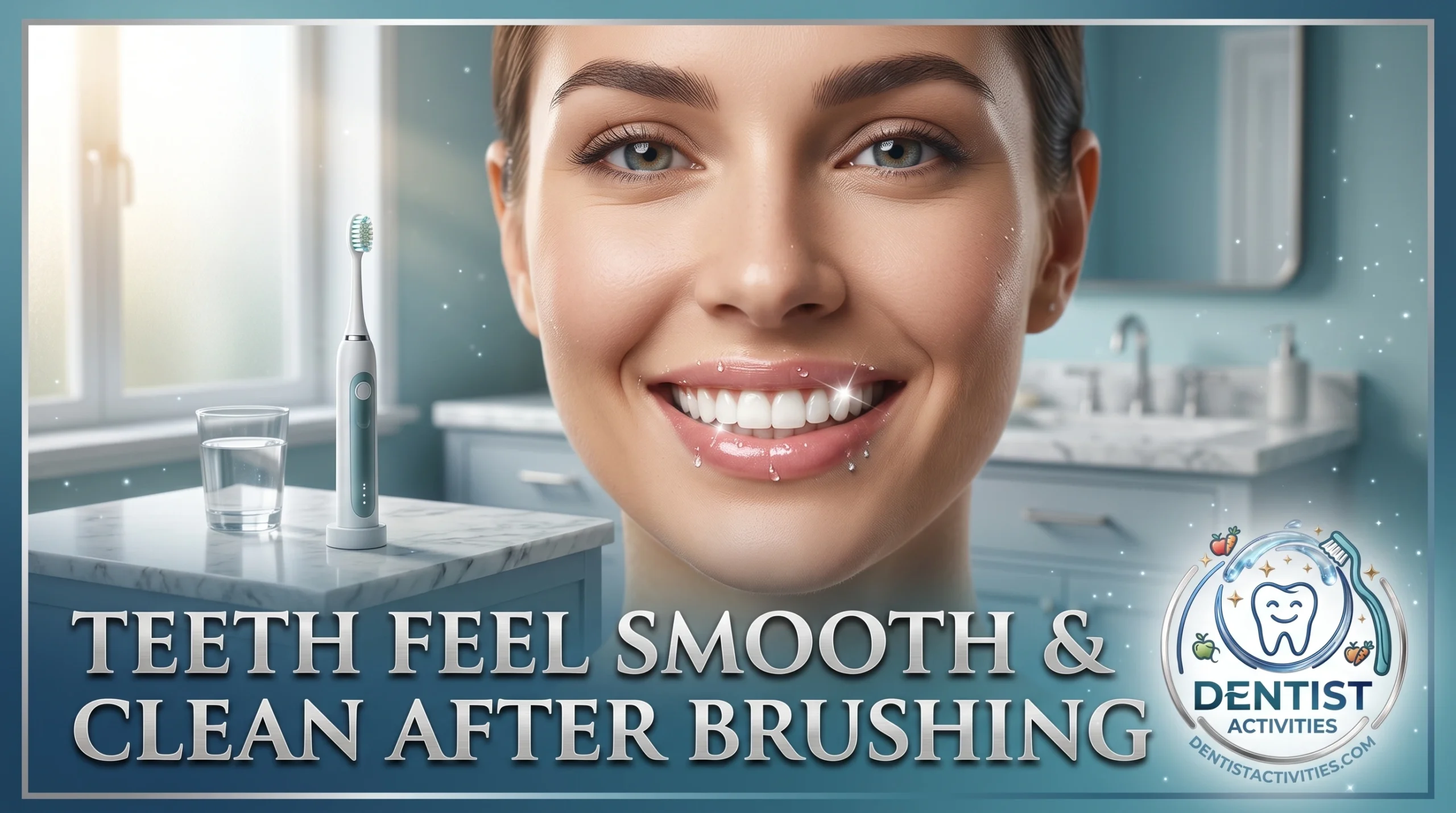
That incredible, squeaky-clean sensation—the one where you glide your tongue over your teeth and they feel perfectly smooth, almost frictionless. For many people, this “my teeth feels smooth and clean after brushing” feeling is the definitive marker of a successful dental hygiene routine. It’s a moment of satisfying reassurance that we’ve won the daily battle against dental plaque.
But what exactly is that smooth feeling? Is it just the texture of clean enamel, or is it something more? Is it always a good thing? And how can we achieve it more consistently?
This detailed guide dives deep into the science behind that fresh-mouth feeling, exploring what plaque is, the difference between smooth and “rough,” how to maintain optimal oral hygiene, and, crucially, when a seemingly perfect smooth tooth might signal an underlying dental issue.
What Does it Mean When “My Teeth Feels Smooth and Clean After Brushing”?
This phrase is perhaps one of the most accurate descriptions of successful oral hygiene. When your teeth feel smooth after brushing, you have effectively achieved two major goals:
- Mechanical Removal of Plaque: Plaque is a biofilm—a sticky, colorless, or pale yellow film of bacteria that constantly forms on your teeth. It is inherently sticky and slightly rough. Brushing uses friction from the bristles and the cleaning agents in toothpaste to mechanically disrupt and remove this biofilm.
- Creation of a Clean Surface: Once the rough plaque is gone, your tongue is interacting directly with the natural surface of your tooth—the enamel. Healthy enamel is the hardest substance in the human body and is exceptionally smooth when it is free of debris.
Therefore, the smooth feeling is the direct result of successful plaque removal. The sensation of smoothness is, quite literally, the absence of friction created by the bacterial film.
The Role of Enamel
Your tooth enamel, which forms the outer layer of the crown, is made primarily of a crystalline mineral called hydroxyapatite. It’s incredibly hard, and in its polished state, it’s smooth. It’s this innate quality of enamel that we feel after a thorough cleaning. If your enamel was naturally rough, plaque removal wouldn’t make your teeth feel smooth.
The Science of a Dirty Mouth: What Makes Teeth Feel Rough?
To understand smoothness, we must first understand its antithesis: roughness. The bumpy, fuzzy, or “coated” feeling on your teeth is caused by several factors, almost all of which are linked to the presence of plaque and the mineralization of that plaque.
1. Dental Plaque (The Biofilm)
Plaque is not just a food residue; it’s a living ecosystem. Immediately after you brush, a “pellicle” forms from your saliva. Bacteria then colonize this pellicle, multiply, and create a complex matrix. As this matrix matures, it becomes denser and harder to remove, leading to that sticky, rough texture.
2. Dental Calculus (Tartar)
If plaque is not removed within roughly 24 to 72 hours, it reacts with the minerals in your saliva (such as calcium and phosphate) and undergoes a process called calcification or mineralization. This transforms the soft, sticky plaque into a hard, cement-like deposit called dental calculus, or tartar.
Unlike plaque, which you can easily remove at home, tartar is bonded firmly to the enamel and can only be removed by a dental professional during a scaling or cleaning procedure. Tartar is incredibly porous and rough, creating an ideal surface for more plaque to attach, which is why teeth feel significantly rougher when tartar is present.
3. Food Debris
Trapped food particles, especially after eating fibrous or sticky foods, directly create a rough texture.
Why the Smooth and Clean Feeling Matters: Health Implications
Achieving that “my teeth feels smooth and clean after brushing” sensation is not just about satisfaction; it’s a critical indicator of positive oral health outcomes. The presence of plaque is the primary cause of almost all dental problems.
Preventing Tooth Decay (Cavities)
The bacteria in plaque use the sugars from the foods you eat to produce acid. This acid attacks the smooth enamel, dissolving the minerals (demineralization) and eventually creating a small hole, or cavity. A smooth tooth is one with minimal plaque, which means minimal acid production and a drastically reduced risk of cavities.
Reducing Gum Disease (Gingivitis and Periodontitis)
Plaque doesn’t just stick to the enamel; it also builds up along and under the gumline. The toxins produced by the bacteria in plaque irritate the gum tissue, leading to inflammation called gingivitis (the early stage of gum disease). If left untreated, gingivitis can progress to periodontitis, which can damage the bone supporting the teeth. Smooth teeth indicate minimal irritation to the gums.
Combating Bad Breath (Halitosis)
Bacteria and their metabolic waste products are the chief source of chronic bad breath. By regularly achieving a plaque-free, smooth tooth surface, you significantly reduce the bacteria count in your mouth, leading to fresher breath.
Enhancing Aesthetic Appearance
Plaque can make teeth appear dull, yellowed, or fuzzy. Removing plaque and tartar reveals the naturally translucent and polished surface of your enamel, contributing to a brighter smile.
The Critical Danger: When “Smooth” Might Be Dangerous (Dental Erosion)
While the phrase “my teeth feels smooth and clean after brushing” is almost always positive, there is a dangerous caveat. If your teeth feel excessively smooth, sensitive to hot or cold, and begin to appear translucent or rounded, it might not be because they are clean; it might be because you are losing enamel through dental erosion.
What is Dental Erosion?
Dental erosion is the chemical wear of tooth enamel. It’s distinct from abrasion (physical wear from brushing) and decay (wear from bacterial acid). Erosion occurs when acid that does not come from bacteria dissolves the enamel.
Common sources of acid include:
- Dietary Acids: Frequent consumption of acidic beverages like soda, sports drinks, fruit juices (especially citrus), and energy drinks.
- Intrinsic Acids: Stomach acid reaching the mouth due to conditions like acid reflux (GERD) or frequent vomiting (often related to eating disorders or morning sickness).
Why Erosion Feels Smooth—and Why It’s Bad
When acid attacks enamel, it doesn’t leave a rough, localized hole like a cavity does. Instead, it etches the entire surface uniformly. This overall melting of the enamel layer can make the teeth feel deceptively smooth.
The Danger: As the protective enamel is worn away, the underlying layer, called dentin, is exposed. Dentin is darker, yellowish, and contains microscopic tubules leading to the tooth nerve, making eroded teeth highly sensitive. Furthermore, because erosion makes the enamel surface porous, the tooth becomes rougher on a microscopic level, making it even easier for plaque to adhere.
Signs a “Smooth” Tooth May Be Eroding:
- Sensitivity: Sudden or increasing sensitivity to hot, cold, or sweet stimuli.
- Discoloration: Teeth appear yellowish (due to exposed dentin) or translucent at the edges.
- Rounded Appearances: The sharp edges of teeth, particularly the incisors, may look rounded or dull.
- Cupping: Small dents or craters may form on the chewing surfaces of the molars.
How to Consistently Achieve “My Teeth Feels Smooth and Clean After Brushing”
Reaching that perfect level of smoothness requires a dedication to effective plaque removal. Here are the most effective strategies.
Optimize Your Brushing Technique
The way you brush matters far more than the pressure you use.
- Angle the Bristles: Place your toothbrush bristles at a 45-degree angle toward the gumline. This is where plaque accumulates most heavily.
- Use Gentle, Circular Motions: Avoid aggressive, back-and-forth scrubbing. Instead, use gentle, circular strokes. Scrubbing can wear down your enamel (abrasion) and recede your gums.
- Brush for Two Minutes: Set a timer. Most people brush for less than 45 seconds, which is insufficient. Focus on cleaning every surface: front, back, and the chewing surfaces.
- Choose a Soft-Bristled Brush: Hard and medium bristles provide little benefit and can cause extensive damage to enamel and gums. Soft or extra-soft bristles are superior for plaque removal and safety.
Upgrade Your Tools
- Electric Toothbrushes: Electric toothbrushes—especially oscillating-rotating or sonic varieties—are consistently shown in clinical studies to remove more plaque than manual brushing. Their rapid movements do the manual work for you, and many have timers and pressure sensors to improve your technique.
- Use Fluoride Toothpaste: While all toothpaste provides the friction needed to remove plaque, fluoride toothpaste is essential because it strengthens enamel through remineralization, making it more resistant to acid and helping to preserve its smooth texture.
Master Interdental Cleaning (The Missed Spots)
Brushing alone only cleans about 60% of your tooth surfaces. The areas between your teeth, where a toothbrush cannot reach, are hotbeds for plaque and tartar. You will never fully achieve that comprehensive smooth and clean feeling without regular interdental cleaning.
- Flossing: String floss is highly effective when used correctly, sweeping the tight spaces between teeth.
- Interdental Brushes: If you have wider gaps (often called black triangles), interdental brushes (small, conical brushes) are often more effective than floss at removing plaque.
- Water Flossers: Water flossers use a pulsed stream of water to flush plaque and debris from between teeth and the gumline. They can be especially helpful for individuals with braces, implants, or dexterity challenges.
The Ultimate Finish: Professional Dental Cleanings (Scaling and Polishing)
Despite our best efforts, plaque often mineralizes into tartar in hard-to-reach areas. Because you cannot remove tartar at home, you need professional intervention to fully restore that glassy, smooth tooth texture.
Dental Scaling
A dental hygienist uses specialized tools, such as ultrasonic scalers (which use sound waves and water to vibrate tartar off) and hand-held scalers, to meticulously remove calculus from both above and below the gumline. This process is essential for oral health and immediately makes the teeth feel smoother.
Dental Polishing
Following scaling, the hygienist will typically polish your teeth. They use a slow-speed handpiece with a rubber cup or a specialized air-polishing system, applying a slightly abrasive “prophy paste.” This process removes extrinsic stains (from coffee, tea, or tobacco) and leaves the enamel exceptionally polished and smooth.
This polishing step is the ultimate way to achieve that definitive, friction-free “my teeth feels smooth and clean after brushing” sensation.
Conclusion: A Smooth Smile is a Healthy Habit
The satisfying sensation that comes when “my teeth feels smooth and clean after brushing” is one of the most immediate rewards of a dedicated oral hygiene routine. It’s the physical confirmation that you have won the battle against plaque, the primary enemy of your smile.
Understanding that this smoothness results from the interaction of your tongue with healthy, polished enamel is key to maintaining it. It requires a combination of gentle but thorough brushing technique, daily interdental cleaning, and regular professional scaling and polishing to remove the inevitable tartar buildup.
Most importantly, we must remain vigilant. If your teeth feel incredibly smooth, yet seem to be eroding, discolored, or sensitive, it is vital to consult your dentist immediately. A smooth surface can be the hallmark of cleanliness, but sometimes it is also the first indicator of damage from dental erosion.
By paying attention to this feeling and understanding its scientific basis, you can turn a satisfying sensation into a powerful metric for tracking and optimizing your lifelong dental health. A smooth, clean smile is a healthy smile.
FAQs (Frequently Asked Questions)
How often should my teeth feel smooth?
Ideally, every time you finish brushing! If you are brushing twice daily with the correct technique, using a soft toothbrush, and flossing once daily, your teeth should feel significantly smooth. If they feel rough, especially along the gumline, you are either missing plaque or already have tartar (calculus), which requires professional removal.
Is an electric toothbrush better for making teeth smooth?
Yes, electric toothbrushes are generally more effective at removing plaque than manual ones. They perform thousands of movements per minute that manual brushing cannot match, leading to a superior clean and a smoother sensation in less time.
Why do my teeth feel rough again just a few hours after brushing?
This is because plaque begins to form immediately after you stop brushing. Saliva contains proteins that quickly form a sticky “pellicle” on your teeth, which bacteria then use as a foundation. While a light coating is normal, if your teeth feel excessively fuzzy very soon after brushing, it might be due to your diet (high sugar/carbohydrates) or dry mouth (xerostomia), which speeds up plaque formation.
My teeth feel very smooth but also very sensitive. Is that normal?
While smoothness is positive, smoothness combined with sensitivity can be a symptom of dental erosion. Erosion is the chemical wear of enamel by acids (like soda or reflux). It etches the entire surface, making it feel deceptively smooth but also porous and sensitive. If this occurs, consult your dentist immediately.
Why does my tongue feel smoother after I brush my teeth?
Because you should be brushing your tongue! The rough surface of your tongue traps significant amounts of bacteria and food particles. Cleaning your tongue with your toothbrush or a tongue scraper removes this debris, making your tongue itself feel smoother and significantly reducing bad breath.