When patients seek tooth replacement in the visible aesthetic zone—the front teeth that show when smiling—the conversation frequently revolves around how natural the final restoration will appear. While dental implants have long been recognized as the gold standard for replacing missing teeth, modern implantology offers two distinct structural approaches: standard root-form implants and mini dental implants (MDIs).
Both options serve vital roles in modern restorative practice, yet each presents distinct biological and aesthetic trade-offs. Evaluating mini dental implants vs standard for aesthetics requires understanding tissue management, emergence profiles, long-term bone remodeling, and prosthetic design. If you are a clinician, dental hygienist, or passionate oral health advocate looking to share clinical insights on restorative treatments, you can also explore how to become a contributor to our clinical knowledge base.
1. Understanding the Structural Differences: Mini vs. Standard Implants
To evaluate cosmetic outcomes, one must first examine the physical dimensions and engineering of both implant types:
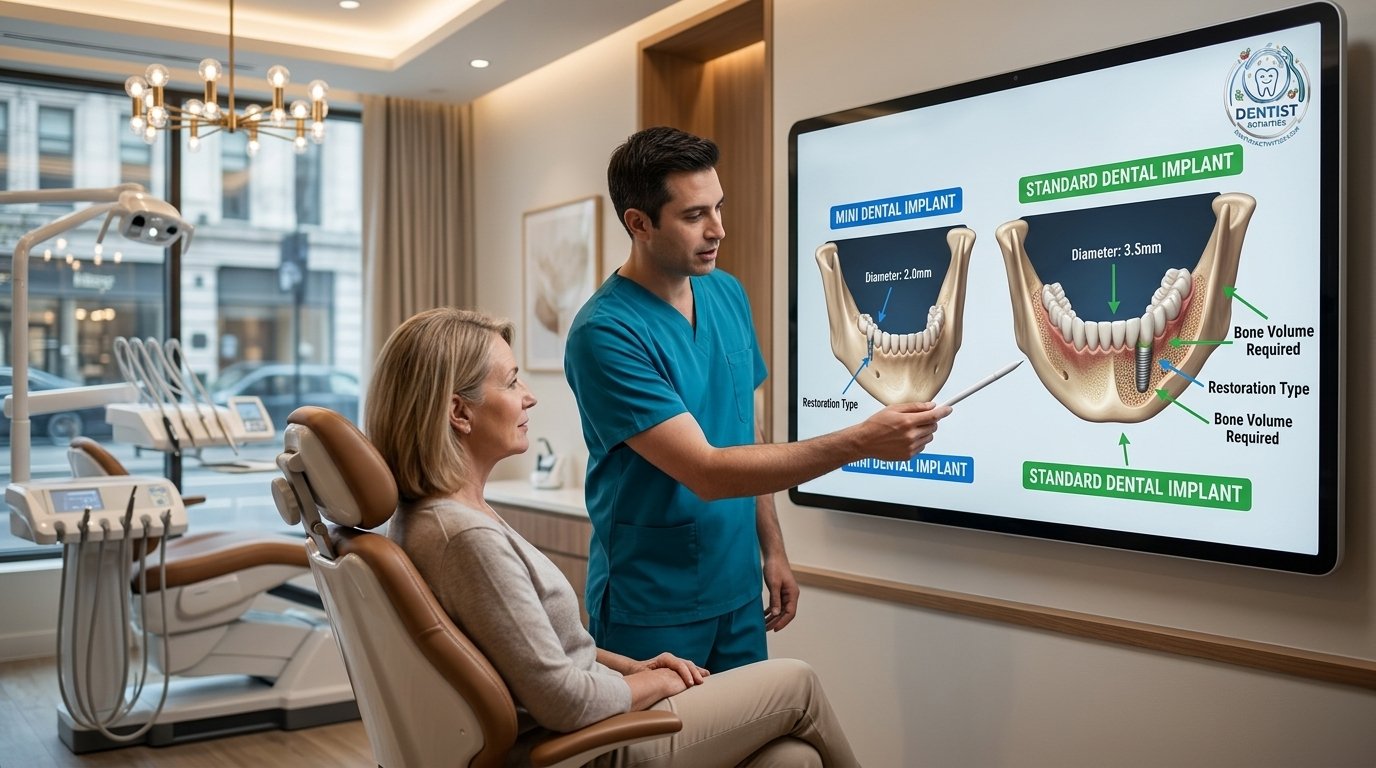
- Standard Dental Implants: Typically measure between 3.4 mm and 5.5 mm in diameter. They consist of a two-piece or three-piece system: the titanium fixture implanted into the alveolar bone, a separate abutment screwed into the fixture, and the final aesthetic crown.
- Mini Dental Implants (MDIs): Typically range from 1.8 mm to 3.0 mm in diameter. They are almost universally manufactured as a solid, single-piece unit where the narrow post and ball/square abutment are integrated into one continuous titanium rod.
Because standard implants feature a wider diameter, they replicate the natural cross-sectional circumference of natural tooth roots (particularly premolars, canines, and molars). In contrast, mini implants were originally engineered for transitional stabilization or denture retention in narrow ridges where bone grafting was either contraindicated or declined by the patient.
2. Emergence Profile and Crown Contour in the Aesthetic Zone
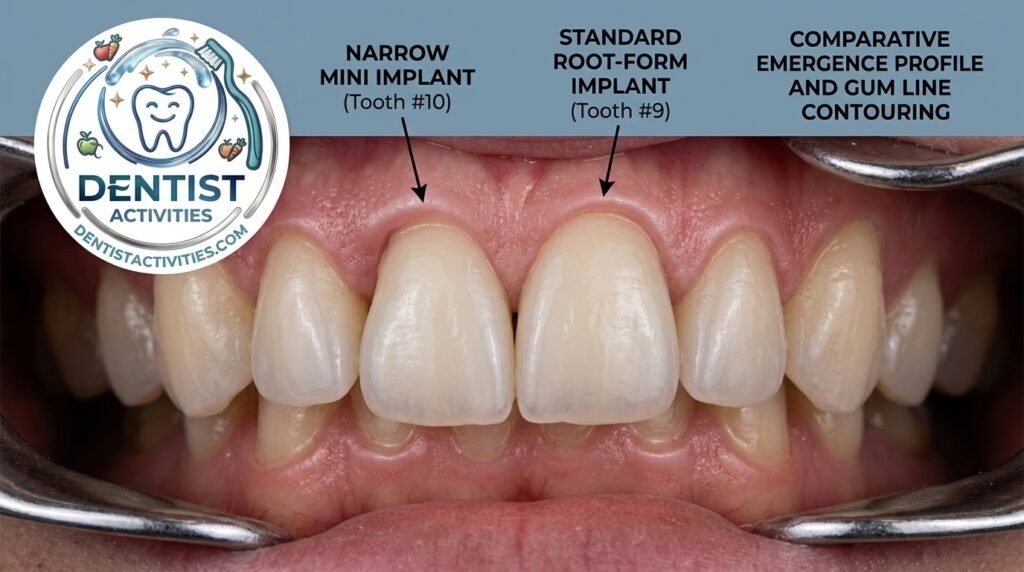
The single most critical determinant of a lifelike anterior restoration is the emergence profile—the contour through which the artificial crown transitions from beneath the gum line to the visible oral cavity.
Why Standard Implants Excel in Natural Contouring
A standard two-piece implant allows clinicians and dental ceramists to customize the abutment shape using materials like zirconia or custom-milled titanium. By customizing the transmucosal collar, the technician creates a gradual, natural flare that matches the scalloped gingival margin of neighboring natural teeth. This ensures that the artificial crown does not appear pinched or artificially narrow at the gumline.
The Aesthetic Challenge with Mini Implants
Because mini implants are ultra-narrow (often under 2.5 mm) and possess a fixed one-piece collar, transitioning from a 2 mm diameter post to a 7–8 mm wide central incisor crown creates a steep, dramatic flare. This anatomical mismatch can lead to:
- Ridge-lap crown designs: The crown must flare outward abruptly, sometimes hovering over the ridge.
- Hygiene difficulty: Sharp undercut angles trap biofilm and food debris.
- Shadowing: Unnatural light refraction near the gingival margin can reveal a slightly artificial appearance under direct lighting.
3. Gingival Papillae and Soft Tissue Preservation
A truly aesthetic smile is defined as much by healthy pink gums (pink aesthetics) as it is by white tooth enamel (white aesthetics).
The Papilla Factor
The interdental papilla—the small triangle of gum tissue between teeth—relies on underlying alveolar bone height and proper contact points. If an implant’s diameter is too wide for a narrow space (such as a congenitally missing maxillary lateral incisor), it can cause bone resorption and loss of the delicate papilla, creating unsightly “black triangles.”
Where Mini Implants Provide an Aesthetic Advantage
In extremely narrow interdental spaces (such as mandibular incisors or peg laterals with limited mesiodistal distance), a standard 3.5 mm implant may crowd the roots of adjacent teeth or violate the critical 1.5 mm clearance required between bone and implant. In these specific anatomical configurations, a mini or narrow-body implant provides the necessary clearance to preserve interproximal bone, thereby supporting natural gum tissue without risking adjacent tooth vitality.
4. Bone Remodeling and Long-Term Aesthetic Stability
Aesthetic success is not measured solely on the day of crown placement; it must endure for decades.
| Clinical Feature | Standard Implants (3.4–5.5 mm) | Mini Dental Implants (1.8–3.0 mm) |
|---|---|---|
| Primary Indication | Single/multiple tooth replacement, full arches | Overdenture stabilization, narrow anterior sites |
| Component Design | Two-piece (fixture + custom abutment) | One-piece solid post |
| Emergence Flexibility | High (fully custom zirconia/titanium) | Limited (fixed pre-machined angle) |
| Bone Stress Distribution | Broad surface area, optimal load dissipation | Concentrated along narrow shaft |
| Grafting Necessity | Frequently required in deficient ridges | Often avoids extensive ridge augmentation |
Standard implants provide substantial surface area for osseointegration, effectively distributing occlusal forces and stimulating adjacent bone remodeling. Mini implants, while effective in lower-stress zones or splinted configurations, experience higher mechanical strain per square millimeter if placed as freestanding single units in high-load areas. If micro-fractures occur in the crestal bone due to off-axis loading, the bone level drops, leading to gingival recession and visible metal margins.
5. Crown Materials and Restorative Flexibility
The interface between the implant and the restorative crown dictates how light passes through the restoration:
- Screw-Retained vs. Cement-Retained: Standard systems allow for screw-retained restorations, eliminating the need for dental cement beneath the gumline, which reduces the risk of peri-implant mucositis. Mini implants almost exclusively rely on cement-retained crowns or O-ring attachments.
- Sub-gingival Shading: Custom zirconia abutments used on standard fixtures can be shaded to match natural dentin. This prevents the dark grey shadow often visible through thin gingival biotypes when metal collars or one-piece titanium mini implants sit close to the facial surface of the gums.
6. Ideal Clinical Candidates for Each Solution
Choosing between mini and standard implants is rarely an arbitrary preference; it is dictated by bone anatomy, cosmetic expectations, and medical health.
When to Choose Standard Implants for Aesthetics:
- Replacing central incisors, canines, or premolars where emergence profile is paramount.
- Patients with high smile lines (gummy smiles) where any marginal asymmetry is readily visible.
- Ample ridge width and bone density, or willingness to undergo site development via bone grafting.
When Mini Implants Are the Pragmatic Aesthetic Solution:
- Extremely tight interdental gaps (e.g., mandibular central/lateral incisors).
- Patients with narrow alveolar ridges who are medically compromised or wish to avoid invasive bone grafts.
- Immediate provisionalization or interim aesthetic support during complex multi-stage reconstruction.
7. Cost, Treatment Timelines, and Patient Satisfaction
Mini dental implants are generally less expensive per unit and can often be placed using minimally invasive, flapless surgical protocols that reduce initial healing times. For patients prioritizing lower cost and rapid restoration, MDIs offer a functional and presentable result.
However, patients with demanding cosmetic expectations who seek an indistinguishable match with adjacent natural teeth frequently achieve superior long-term results with standard implants paired with custom CAD/CAM abutments and layered ceramic crowns.
8. Share Your Expertise: Become a Contributor to Our Dental Network

Are you a practicing dentist, prosthodontist, periodontist, or dental researcher with firsthand experience in implant aesthetics and tissue management? We welcome insightful clinical case reviews, evidence-based comparisons, and practical practice insights.
When you become a contributor, you join a collaborative community dedicated to publishing transparent, patient-centric, and clinically grounded dental education.
What We Look For in Contributor Submissions:
- Original Clinical Insights: Real-world observations on tissue contouring, material selection, or surgical protocols.
- Balanced Perspectives: Objective analyses that explore both the benefits and limitations of modern dental modalities.
- Educational Value: Clear, structured writing that bridges the gap between complex surgical terminology and patient understanding.
If you have a unique perspective or clinical case study you would like to share, visit our contributor portal to review our editorial guidelines and submit your article pitch.
Conclusion
When weighing mini dental implants vs standard for aesthetics, the decision hinges on specific anatomical dimensions and aesthetic demands. Standard implants remain the premier choice for anterior smile zones requiring natural emergence profiles and custom soft-tissue scalloping. Mini dental implants, while possessing limitations in emergence flexibility, provide a reliable, minimally invasive alternative for narrow interdental spaces and bone-deficient ridges.
Frequently Asked Questions (FAQs)
Do mini dental implants look as natural as standard implants?
In narrow spaces, such as lower front incisors, mini dental implants can look very natural. However, for wider teeth like upper front incisors or premolars, standard implants generally produce a more seamless emergence profile and a more natural gum contour.
Can a mini dental implant show through the gums?
In patients with thin gum tissue (thin gingival biotype), the metallic titanium collar of a mini implant can occasionally produce a faint grayish tint near the gumline. Standard implants can use tooth-colored zirconia abutments to prevent this discoloration.
How long do mini implants last compared to standard implants in aesthetic areas?
Both implant types can achieve high success rates when placed in suitable clinical conditions. Standard implants have decades of longitudinal data supporting 20+ year lifespans, while mini implants have strong track records when occlusal loads are properly managed and bone volume is respected.
Is bone grafting always necessary for standard aesthetic implants?
Not always, but bone grafting or soft-tissue grafting is often recommended in the aesthetic zone to ensure sufficient volume for ideal implant positioning and long-term papilla support. Mini implants are frequently chosen specifically to avoid bone grafting when ridge width is compromised.