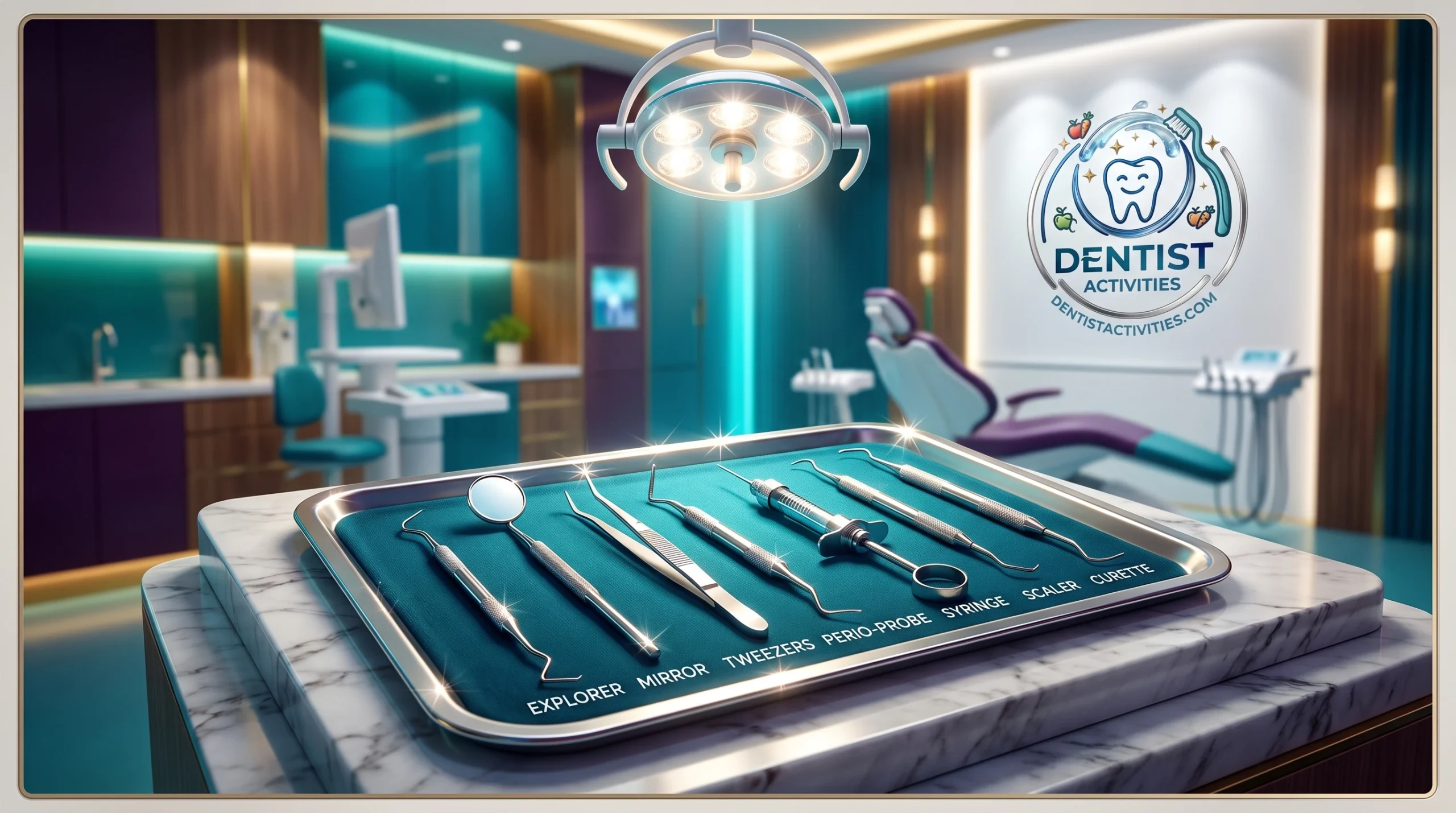
Stepping into a dental clinic can feel overwhelming when you see a tray lined with shiny stainless steel instruments, angled hooks, and precision devices. For dental students, prospective assistants, hygienists, or curious patients wanting to demystify their next appointment, understanding dentist tools names and pictures transforms what looks like an intimidating setup into an organized kit for oral health care.
Every tool on a dental tray serves a dedicated clinical purpose. From early cavity detection to complex surgical extractions, dental instruments are engineered with ergonomic handles, precise angulations, and specialized tips to work within the tight confines of
Core diagnostic dental instruments. Source: iStock
1. Diagnostic and Examination Instruments
Diagnostic tools form the baseline setup for every general checkup. They allow the clinician to view inaccessible areas, assess enamel hardness, measure gum attachment, and manipulate small materials.
Dental Mouth Mirror
- Visual Appearance: A slender metal handle terminating in a small, angled circular mirror (flat, concave, or front-surface).
- Primary Function:
- Indirect Vision: Lets the clinician view the lingual (tongue side) and distal surfaces of teeth.
- Indirect Illumination: Bounces the overhead operatory light into dark regions of the mouth.
- Transillumination: Shines light through anterior teeth to reveal interproximal decay.
- Tissue Retraction: Gently holds back cheeks, lips, and tongue during examination.
Sickle Explorer (Dental Probe / Shepherd’s Hook)
- Visual Appearance: A thin, flexible metal instrument featuring a sharp, curved hook (commonly the #23 Shepherd’s Hook).
- Primary Function: Enhances tactile sensitivity to detect enamel softening, subgingival calculus, margins of restorations, and pit-and-fissure caries.
Cotton Pliers (Dental Tweezers)
- Visual Appearance: Angled tweezers with serrated or smooth locking tips.
- Primary Function: Grasping, placing, and retrieving small items such as cotton rolls, articulating paper, gauze, and retraction cord without cross-contamination.
2. Periodontal and Scaling Instruments
Periodontal instruments are designed to remove plaque, calculus (tartar), and bacterial toxins from tooth surfaces above and below .
Sickle scaler vs. curette tip design. Source: SurgiMac Dental Supply
Periodontal Probe
- Visual Appearance: A straight or slightly curved rod marked with precise millimeter graduations (such as UNC-15 or Marquis markings), terminating in a blunt, rounded tip.
- Primary Function: Measures periodontal pocket depth, assesses clinical attachment levels, and records bleeding on probing to evaluate gum health.
Sickle Scaler
- Visual Appearance: Features a triangular cross-section with two sharp cutting edges converging at a pointed tip.
- Primary Function: Supragingival calculus removal. Because of its pointed tip, it is strictly used above the gumline to prevent soft-tissue laceration.
Universal and Gracey Curettes
- Visual Appearance: Features a semicircular cross-section with a rounded toe and rounded back.
- Primary Function: Subgingival scaling and root planing.
- Universal Curette: Designed with a 90-degree blade angle to treat all tooth surfaces.
- Gracey Curette: Area-specific (e.g., Gracey 1/2 for anterior teeth, 13/14 for distal posterior surfaces) with an offset 70-degree blade for deep periodontal pocket debridement.
3. Rotary Instruments and Handpieces
Dental handpieces are mechanical powerhouses, utilizing pneumatic or electric power to rotate burs and polishing cups at speeds ranging from a few hundred to over 400,000 RPM.
| Handpiece Type | Speed Range | Key Attachments | Primary Clinical Applications |
|---|---|---|---|
| High-Speed Handpiece | 250,000 – 450,000 RPM | Diamond & Carbide Burs | Cutting enamel, cavity preparation, crown reduction, sectioning teeth |
| Low-Speed Handpiece | 5,000 – 40,000 RPM | Contra-angle, Straight nose cone | Removing deep dentinal decay, finishing, polishing restorations |
| Prophy Handpiece | 2,500 – 5,000 RPM | Rubber prophy cups, Brushes | Prophylaxis polishing, extrinsic stain removal |
Dental Burs
- Visual Appearance: Miniature drill bits made of tungsten carbide, diamond grit, or stainless steel with varied head shapes (round, inverted cone, pear-shaped, cross-cut fissure).
- Primary Function: Excavating tooth decay, contouring restorations, refining margins, and cutting hard tissue.
4. Restorative and Filling Instruments
Once decay is cleared, restorative tools place, pack, carve, and polish direct restorative materials like composite resin and dental amalgam.
Spoon Excavator
- Visual Appearance: Double-ended instrument featuring miniature spoon-shaped concave blades.
- Primary Function: Manually scoops out soft, necrotic dentin from deep cavities without risking pulpal exposure from rotary burs.
Amalgam and Composite Condensers (Pluggers)
- Visual Appearance: Flat-ended cylindrical or serrated metal tips in varying diameters.
- Primary Function: Packs and condenses restorative material firmly into the cavity preparation to eliminate air voids.
Burnishers (Ball, Acorn, Egg, Football)
- Visual Appearance: Smooth, rounded metal working ends shaped like balls, acorns, or footballs.
- Primary Function: Smooths restorative margins, sculpts occlusal anatomy into unset amalgam, and burnishes matrix bands.
Carvers (Hollenback and Discoid-Cleoid)
- Visual Appearance: Sharp-edged blade instruments; the discoid-cleoid features a disc-shaped end paired with a pointed claw end.
- Primary Function: Carves functional anatomical grooves, cusps, and marginal ridges into direct fillings before full curing.
Composite Placement Instruments
- Visual Appearance: Non-stick, titanium- or Teflon-coated blades, spatulas, and paddle tips.
- Primary Function: Transports, layers, models, and shapes resin composite material to blend with natural tooth morphology.
5. Surgical and Extraction Instruments
Oral surgery requires instruments capable of delivering controlled mechanical leverage to elevate roots and expand alveolar bone
Comprehensive surgical instrument tray. Source: Oxymedz
Dental Extraction Forceps
- Visual Appearance: Heavy plier-like instruments with specialized beaks contoured to grip anatomical crown and root shapes.
- Maxillary (Upper) Forceps: Beaks aligned roughly parallel with the handle.
- Mandibular (Lower) Forceps: Beaks angled at roughly 90 degrees to the handle for downward leverage.
- Cowhorn Forceps (#23): Pointed twin beaks designed to seat directly into the bifurcation of mandibular molars.
Dental Elevators (Straight, Cryer, Apexo)
- Visual Appearance: Thick, sturdy handles with wedge-shaped, pointed, or teardrop blades.
- Primary Function: Luxates teeth by applying lever and wheel-and-axle forces, severing periodontal ligament fibers, and expanding the bony socket prior to forceps application.
Periosteal Elevator (Molt #9)
- Visual Appearance: Double-ended tool with one pointed blade and one broader, rounded spoon edge.
- Primary Function: Reflects and separates the mucoperiosteal flap from the underlying alveolar bone during surgical procedures.
Bone Rongeurs and Bone Files
- Visual Appearance: Spring-loaded nippers (rongeurs) and textured multi-directional rasp blades (files).
- Primary Function: Trims, resects, and smooths sharp alveolar bone crests following multiple extractions (alveoloplasty).
6. Endodontic (Root Canal) Tools
Endodontics involves cleaning, shaping, and sealing the microscopic root canal system inside the tooth.
- Endodontic Explorer (DG16): Double-ended probe with long, straight, ultra-sharp tines designed to locate canal orifices on the pulp chamber floor.
- Endo Files (K-Files and Hedstrom Files): Flexible, color-coded, tapered stainless steel or nickel-titanium (NiTi) needles with spiral cutting flutes used to clean and widen root canals.
- Barbed Broaches: Slender wire filaments with tiny backward-facing barbs designed to extirpate vital or necrotic pulp tissue intact.
- Endodontic Spreaders and Pluggers: Pointed (spreader) or flat-ended (plugger) instruments used for lateral and vertical condensation of gutta-percha cones.
7. Retraction, Isolation, and Moisture Control Tools
Maintaining a dry, clear operating field is essential for bonding adhesives and surgical safety.
- Rubber Dam Clamp and Forceps: A spring-loaded metal clip that anchors a flexible latex/nitrile sheet around the tooth, isolating it from saliva, blood, and the airway.
- Saliva Ejector: A narrow, flexible plastic tube providing low-volume suction to evacuate pooled saliva from the floor of the mouth.
- High-Volume Evacuator (HVE): A wide-bore rigid suction tip that rapidly captures water spray, aerosol plumes, and solid debris generated by high-speed handpieces.
- Minnesota Cheek Retractor: An offset, bent stainless steel blade that keeps cheeks, lips, and tongue retracted during surgical incisions and flap manipulation.
8. Instrument Comparison: Similar Tools Explained
Because several instruments look nearly identical to the untrained eye, comparing their unique geometric features helps prevent clinical confusion.
| Instrument A | Instrument B | Key Difference in Appearance | Functional Distinction |
|---|---|---|---|
| Sickle Scaler | Curette | Scaler has a sharp point and triangular cross-section; curette has a rounded toe and semi-circular cross-section. | Scalers operate supragingivally; curettes operate safely subgingivally. |
| Straight Elevator | Spoon Excavator | Elevator has a massive, heavy handle and thick wedge; excavator is a light, thin-handled precision hand instrument. | Elevators luxate entire teeth; excavators scoop soft tooth decay. |
| Explorer | Periodontal Probe | Explorer has a sharp, needle-like tip; probe has a blunt tip with measured millimetric increments. | Explorers detect decay and margins; probes measure gum pocket depths. |
| Amalgam Plugger | Burnisher | Plugger has flat or serrated ends; burnisher has smooth, rounded geometrical shapes. | Pluggers compress filling material; burnishers smooth and shape surface contours. |
9. Modern Digital and Ultrasonic Dental Technology
Contemporary practices increasingly integrate digital and power-driven units alongside standard hand tools:
- Ultrasonic Piezo / Magnetostrictive Scalers: High-frequency vibrating tips (25,000–45,000 Hz) combined with water cavitation that break down heavy calculus deposits faster and with less manual pressure than hand scaling.
- Intraoral 3D Scanners: Wand-style optical capture devices that project structured light or lasers to generate true-color 3D digital impressions, replacing traditional alginate putty trays.
- Digital Apex Locators: Electronic monitoring devices that measure impedance to determine the exact apical foramen position during endodontic treatment.
- Air Abrasion Units: Micro-sandblasting tools emitting aluminum oxide particles to prepare minimal enamel cavities without vibration or heat.
10. Sterilization, Maintenance, and Tray Setups
A systematic workflow ensures every instrument remains sterile and sharp:
- Decontamination and Ultrasonic Cleaning: Used instruments are soaked and agitated in enzymatic ultrasonic baths or automated thermal washer-disinfectors to remove bioburden.
- Inspection and Sharpening: Hand scalers and curettes are evaluated on acrylic test sticks and re-edged using Arkansas or India sharpening stones.
- Pouching with Chemical Indicators: Instruments are organized into color-coded cassettes or sealed sterilization pouches with internal chemical indicator strips.
- Autoclaving: Saturated steam under pressure (typically at 121°C for 30 minutes or 134°C for 4–5 minutes) destroys all microbial life and spores.
Summary of Essential Dental Instruments
Navigating dentist tools names and pictures makes clinical dentistry transparent and approachable. Whether it is the precision feedback of a Shepherd’s Hook explorer, the targeted subgingival contour of a Gracey curette, or the controlled leverage of an extraction elevator, each device is tailored for clinical ergonomics and patient safety. Mastering these names, tip geometries, and clinical functions is the first step toward clinical proficiency and dental health literacy.
Frequently Asked Questions
What are the four most common dentist tools used in a standard checkup?
The standard basic examination setup consists of four fundamental tools:
- Dental mouth mirror (for indirect vision and illumination)
- Sickle explorer / probe (for tactile cavity detection)
- Periodontal probe (for measuring pocket depths)
- Cotton pliers (for handling materials)
Why do some dental tools have sharp hooks while others are rounded?
Pointed tools (like sickle scalers and explorers) are designed for tactile precision and hard-tissue scaling above the gumline. Rounded tools (like curettes and periodontal probes) prevent soft tissue damage and puncture wounds when working below the delicate gingival margin.
What is the difference between a high-speed and low-speed dental drill?
High-speed handpieces run between 250,000 and 450,000 RPM with water coolant to slice through enamel and prepare cavities. Low-speed handpieces operate between 5,000 and 40,000 RPM, delivering higher torque for removing soft dentin decay, adjusting prosthetics, and polishing teeth.
What tool does the dentist use to measure gum pockets?
Dentists and hygienists use a periodontal probe, a thin, blunt instrument marked with millimeter lines (like a miniature ruler) to measure the sulcus depth around each tooth. Pockets measuring 1–3 mm are generally healthy, while measurements of 4 mm or greater can indicate periodontal inflammation or bone loss.
Explore related dental clinical guides:
Step-by-step dental assistant tray setup guide
Periodontal probe types and reading markings